

Smart Daily Strategies for Securing Vitamin B12
When it comes to vitamin B12, the biggest obstacle to maintaining healthy levels is rarely how much you consume. The…
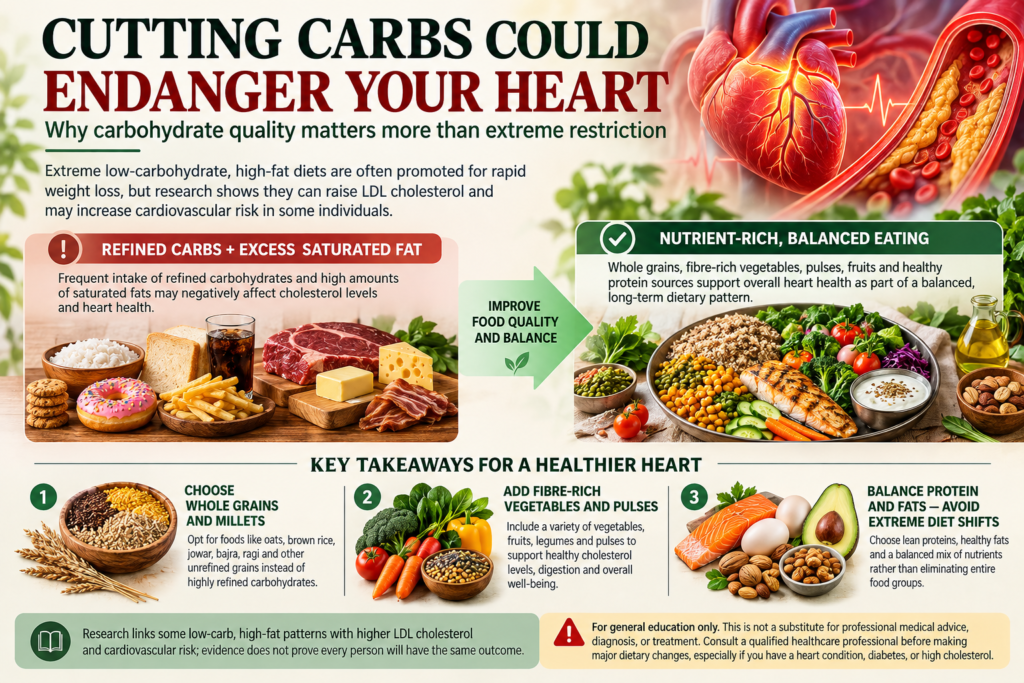
When a healthy 51-year-old man decided to lose a few pounds, he chose a path millions of people around the world take every day: a strict, low-carbohydrate diet. He had no history of heart disease, his cholesterol levels were well within a safe range, and his overall physical health was excellent. Yet, just two and a half years after cutting carbs from his daily meals, he found himself in an emergency room facing a nearly complete blockage in a major coronary artery.
Whether referred to as Atkins, keto, or a carnivore diet, these dietary trends share a common core philosophy: drastically reducing carbohydrate intake while sharply increasing fats and proteins. While these diets are frequently promoted on social media for rapid weight loss, their impact on long-term cardiovascular health tells a far more complicated story. This article explores a documented clinical case report, examines population-level research on low-carb eating patterns, and provides an accurate breakdown of what Indian health authorities actually recommend for safe, long-term nutrition.
Medical Disclaimer: This article discusses a single published medical case report alongside broader scientific research and is intended for general educational purposes only. It is not a substitute for professional medical advice, diagnosis, or treatment. Do not start, stop, or significantly modify your diet based on this content alone, particularly if you have an existing heart condition, diabetes, or high cholesterol. Always consult a qualified doctor or registered dietitian before making major dietary changes.
The patient’s journey provides a detailed look at how extreme dietary shifts can affect internal health parameters over a relatively short timeframe. Before starting his dietary regimen, he was active, non-obese, and possessed clean cardiovascular health metrics. A routine medical screening confirmed normal blood lipid levels, healthy circulatory function, and an absence of cardiovascular disease indicators.
Looking to drop a modest amount of body weight, he initiated a strict low-carbohydrate, high-fat eating strategy. His daily meals shifted heavily toward animal fats, red meats, cheeses, and oils, while eliminating whole grains, fruits, and starchy vegetables.
Within just four weeks on the low-carb plan, routine blood tests revealed a sharp increase in his total serum cholesterol and low-density lipoprotein (LDL) levels. Because he had successfully lost five pounds during those initial weeks, he chose to ignore the elevated cholesterol readings and remained strictly on the diet.
Over the following two years, his weight loss stalled significantly; he dropped only three additional pounds despite maintaining rigid dietary restrictions. More concerningly, new systemic symptoms began to surface. He began experiencing progressive erectile dysfunction, alongside mild, episodic chest tightness during physical exertion. Rather than recognizing these symptoms as potential signs of circulatory compromise, he continued his dietary routine.
Two and a half years after starting the diet, the patient was rushed to the hospital with severe, crushing chest pain. Diagnostic imaging and emergency coronary angiography revealed a critical 99% obstruction in his left anterior descending coronary artery. Cardiologists performed an immediate intervention, deploying a drug-eluting stent to clear the obstruction and restore blood flow to his cardiac muscle.
What makes this clinical case particularly notable is the rapid timeline. Cardiovascular assessments performed shortly before he adopted the low-carbohydrate diet showed no evidence of underlying coronary artery disease. The near-total arterial occlusion developed entirely within the two-and-a-half-year period during which he adhered to high-fat, low-carbohydrate eating.
Following his emergency hospital release, the patient made an immediate decision to abandon the low-carbohydrate, high-fat regimen entirely. Under medical guidance, he adopted a whole-food, plant-based, low-fat diet centered on vegetables, legumes, whole grains, and fresh fruits.
Within two months of making this complete dietary transition, his health metrics transformed dramatically:
To summarize his progression, the patient began with clean cardiac markers and normal cholesterol. After one month on a low-carb diet, he lost 5 pounds but experienced an immediate spike in LDL cholesterol. By two and a half years, he had lost only 3 more pounds while developing erectile dysfunction, chest pain, and a 99% coronary blockage. Finally, after switching to a plant-rich, low-fat diet post-intervention, his lab values normalized and his symptoms cleared completely.
It is vital to frame these clinical outcomes with precision. While the patient experienced complete symptom resolution and dramatic improvements in his blood lipid markers, this case report does not prove an anatomical “reversal” of arterial plaque.
Repeat coronary angiography was not performed post-recovery to inspect the physical interior of the artery, as invasive imaging is reserved for active clinical emergencies. Therefore, medical science interprets this patient’s outcome as successful symptom resolution and rapid normalization of metabolic and cardiovascular lab values, rather than confirmed arterial plaque regression.
In medical literature, a single case report serves as a valuable clinical observation, an illustration of what can happen to a specific individual under particular circumstances. However, one individual’s outcome cannot prove that low-carbohydrate diets will cause identical heart disease in every person. To understand broad population risks, researchers turn to large-scale epidemiological studies.
To evaluate the broader impacts of low-carb eating, researchers analyzed health data from thousands of participants in the UK Biobank. This prospective cohort study was presented at the American College of Cardiology’s 2023 scientific session (ACC.23 / World Congress of Cardiology).
The study evaluated participants following a self-reported low-carbohydrate, high-fat (keto-style) diet. These individuals exhibited significantly higher levels of LDL cholesterol and apolipoprotein B. Most critically, the data revealed that participants on low-carb, high-fat diets faced approximately double the risk of major adverse cardiovascular events, including increased rates of heart attacks, strokes, angina, and revascularization procedures, compared to those on standard diets.
Researchers noted that cardiovascular risk was particularly pronounced among individuals whose baseline LDL cholesterol was already elevated prior to starting the diet.
Important Study Context: Because this findings paper was presented as a conference abstract rather than a finalized, peer-reviewed journal publication, and relied on self-reported dietary questionnaires, it demonstrates a strong observational association rather than direct clinical causation. Nevertheless, it provides compelling population-level evidence that supports the clinical concerns raised by individual case reports.
Major cardiovascular health organizations across the globe have evaluated popular diets to determine their long-term impact on arterial and metabolic health.
In a 2023 scientific statement published in Circulation, the American Heart Association formally evaluated 10 popular dietary patterns against established criteria for heart-healthy eating.
Cardiologists associated with Guy’s and St Thomas’ Specialist Care (affiliated with the British Heart Foundation) emphasize that strict ketogenic diets typically derive 70% to 80% of their total daily calories from fat. This level far exceeds standard medical recommendations for lipid management. Their clinical consensus advises against completely eliminating entire macro-nutrient food groups, advocating instead for sustainable, balanced nutritional habits.
The goal for Indian metabolic health is to reduce the overall volume of refined carbohydrates while simultaneously increasing high-fiber whole foods and healthy proteins. Extreme elimination diets represent an unnecessary jump from one nutritional imbalance to another. For a broader perspective on Indian national nutrition policies, explore India’s broader dietary guidelines.
To understand carbohydrate risks in the Indian population, the Indian Council of Medical Research (ICMR) conducted the landmark ICMR-INDIAB study, examining dietary patterns and metabolic risk factors across tens of thousands of Indian adults.
The study revealed crucial insights regarding carbohydrate consumption:
Crucially, the study noted that simply substituting white rice with basic milled wheat did not lower metabolic risk if total carbohydrate volume remained excessively high. However, replacing a portion of refined carbohydrate calories with high-quality plant proteins, dairy, eggs, or fish was directly correlated with a lower risk of developing type 2 diabetes.
The findings of the ICMR-INDIAB study are frequently misconstrued. The research does not suggest that Indians should abandon carbohydrates entirely or adopt extreme, high-fat ketogenic diets.
Instead, the ICMR’s evidence points directly toward moderation and quality improvement. The goal for Indian metabolic health is to reduce the overall volume of refined carbohydrates while simultaneously increasing high-fiber whole foods and healthy proteins.
Incorporate daily servings of leafy greens and a wider variety of antioxidant-rich vegetables to support healthy vascular function and cholesterol clearance.
Key dietary strategies include:
Note: Individuals diagnosed with heart disease, chronic kidney conditions, diabetes, or severe hyperlipidemia should seek personalized dietary advice from a clinical dietitian or cardiologist before altering their daily macronutrient ratios.
A low-carbohydrate, high-fat diet can significantly elevate LDL cholesterol and apolipoprotein B levels in certain individuals, which are established risk factors for cardiovascular plaque accumulation. While individual responses vary, clinical case reports and prospective population studies show a clear association between extreme low-carb patterns and an increased risk of major cardiac events.
Short-term weight loss often occurs on keto due to rapid fluid loss and calorie restriction. However, blood lipid markers can spike within just a few weeks of starting the diet. Individuals with underlying lipid abnormalities or early-stage vascular disease may experience cardiovascular strain even during short-term adherence.
The ICMR recommends moderating carbohydrate quantity and improving carbohydrate quality. Because the typical Indian diet derives roughly 62% of its calories from carbohydrates, mostly refined grains, the ICMR advises shifting away from refined white rice and maida toward unrefined whole grains, millets, vegetables, and increased dietary protein. It does not recommend zero-carbohydrate or high-fat ketogenic diets.
Safer, heart-healthy alternatives include the Mediterranean diet, the DASH diet, or a balanced approach to protein and vegetables. These dietary patterns promote weight management through high-fiber whole grains, legumes, vegetables, and healthy proteins without exposing the cardiovascular system to excessive saturated fats.

When it comes to vitamin B12, the biggest obstacle to maintaining healthy levels is rarely how much you consume. The…

Medical Disclaimer: This article is for general educational purposes and is not medical or nutritional advice. Research on antioxidant activity…
Medical Disclaimer: The information provided in this article is for educational and informational purposes only and is not intended as…
