Cut Trans Fats to Protect Breast Cancer Survivors

Blogs  /  Cut Trans Fats to Protect Breast Cancer Survivors

Cut Trans Fats to Protect Breast Cancer Survivors
October 21, 2026 12 min read
Breast Cancer Survivors Trans Fats

Cut Trans Fats to Protect Breast Cancer Survivors

For millions of women who have completed breast cancer treatment, the transition into survivorship is marked by both relief and reflection. Alongside routine follow-up care and lifestyle adjustments, one question arises almost immediately: “What should I eat now?” As medical research continues to explore how everyday nutrition influences long-term recovery and general health, dietary fats—particularly industrial trans fats—have come under intense scientific scrutiny.

A major observational study following thousands of breast cancer survivors found that women who consumed the highest amounts of saturated and trans fats after diagnosis experienced a significantly higher risk of dying from any cause over approximately seven years compared to those with the lowest intake. While these findings offer important insights, understanding what they mean for an individual requires a calm, evidence-based perspective that accounts for both the strengths and limitations of nutritional science.

This article examines the research behind trans fats and post-diagnosis health, breaks down where industrial trans fats are found in everyday diets, reviews global and Indian regulatory standards, and provides practical, everyday kitchen steps for breast cancer survivors and their families.

Disclaimer: This article is for general educational purposes only and does not constitute medical or nutrition advice. Research findings describe groups of women and cannot predict any individual’s medical outcome. Please discuss any dietary changes with your oncologist or a registered dietitian, especially during or soon after cancer treatment.

What the Research Found About Dietary Fat After Breast Cancer

To understand how diet interacts with health after cancer, researchers frequently turn to long-term observational cohort studies that track dietary habits across large populations over several years.

How the Study Was Done

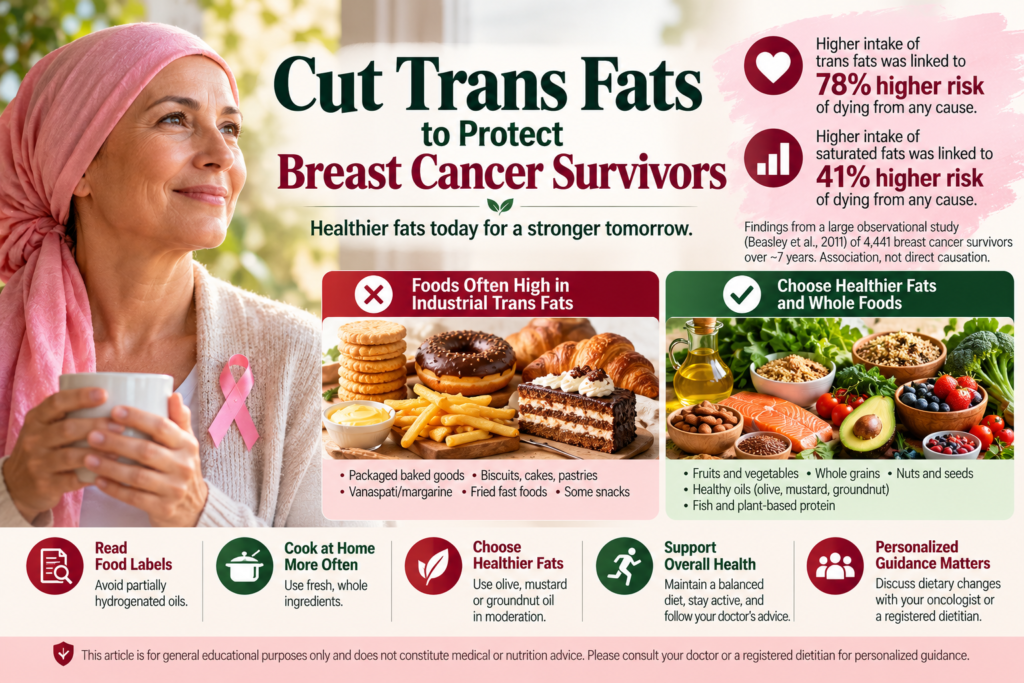
In a landmark publication in Breast Cancer Research and Treatment, Beasley et al. (2011) evaluated the post-diagnosis diets of 4,441 women diagnosed with invasive breast cancer. Participants completed a detailed 126-item food frequency questionnaire assessing their typical dietary intake after their initial diagnosis, and researchers tracked their health outcomes over an average follow-up period of about seven years.

Because this was an observational study, researchers observed natural variations in what the participants chose to eat rather than assigning specific diets in a controlled trial. Observational studies are valuable for identifying broad patterns across populations, though they cannot single-handedly establish direct cause-and-effect relationships.

The Key Numbers

When comparing participants in the highest fifth of post-diagnosis fat intake to those in the lowest fifth, the study observed notable differences in overall survival:

  • Saturated Fat: Women with the highest intake had a 41% higher risk of dying from any cause over the follow-up period.
  • Trans Fat: Women with the highest intake had a 78% higher risk of dying from any cause.

These percentage increases were calculated after statistical adjustments for confounding factors such as age, disease stage, initial treatment type, body weight, and physical activity levels. Crucially, these hazard ratios apply to all-cause mortality—meaning death from any cause, including cardiovascular events. While similar trends were observed for breast cancer-specific mortality, those specific associations did not reach statistical significance.

How to Read These Numbers Carefully

When evaluating high percentage figures in health reporting, maintaining scientific context is essential to avoid unnecessary alarm or misunderstanding.

  1. Association, Not Direct Causation: As an observational study, the research demonstrates a link between high trans fat intake and higher mortality, but it does not prove that trans fats directly caused the deaths.
  2. Single Dietary Assessment: Dietary intake was measured at a single point in time via self-reported questionnaires, which may not capture changes in eating habits over subsequent years.
  3. Historical Era of Study: The participants were diagnosed between 1987 and 1999. During that period, average consumption of industrial trans fats in Western diets was substantially higher than it is today, before modern regulatory limits were introduced.
  4. Mixed Broader Evidence: A comprehensive systematic review of 18 studies investigating dietary fat subtypes after breast cancer diagnosis described the overall evidence base as mixed and limited. While two studies noted elevated risk figures for trans fat (including the 78% figure from Beasley et al.), other studies showed less conclusive results regarding cancer-specific survival.
  5. Multiple Factors in Survival: Long-term cancer survivorship is influenced by a complex interplay of clinical factors, including tumor biology, cancer stage, adherence to prescribed therapies, physical activity, and baseline cardiovascular health.

Reducing industrial trans fats is a prudent, low-risk dietary modification supported by health organizations worldwide, but it is one element of holistic health rather than a standalone guaranteed protective measure.

What Are Trans Fats and Where Are They Found?

Trans fatty acids, or trans fats, exist in two main forms: industrially produced trans fats and naturally occurring trans fats.

  • Industrial Trans Fats: Created through partial hydrogenation—a chemical process where hydrogen is added to liquid vegetable oil to make it solid at room temperature. This process extends shelf life and creates desirable textures for commercial baking and frying. Common sources include vanaspati, commercial margarine, bakery shortening, packaged biscuits, microwave popcorn, and commercially fried foods.
  • Natural Trans Fats: Small amounts of trans fats occur naturally in the dairy products and meat of ruminant animals (such as cows, goats, and sheep). The Food Safety and Standards Authority of India (FSSAI) and global health bodies note that natural trans fats consumed in normal, moderate dietary amounts are not associated with the same health risks as industrial trans fats.
  • Thermal Degradation: Heating vegetable oils to extreme temperatures or repeatedly reusing frying oil can also degrade oil quality, generating Total Polar Compounds and small amounts of trans fats.

How Might Trans Fats Affect the Body?

While the relationship between trans fat intake and cancer progression remains an area of ongoing research, scientists have hypothesized several biological pathways through which high trans fat consumption may impact general cellular health:

  • Systemic Inflammation: Industrial trans fats have been shown to promote systemic inflammatory markers in blood plasma, such as C-reactive protein (CRP) and inflammatory cytokines. Chronic systemic inflammation creates an environment that can impair immune surveillance and general physiological function.
  • Cell Membrane Structure: Trans fats incorporate into lipid bilayers, potentially altering cell membrane fluidity, receptor function, and intercellular signaling pathways.
  • Insulin Resistance: High intake of partially hydrogenated oils may impair insulin sensitivity, leading to elevated circulating insulin and insulin-like growth factors, which are studied for their roles in cellular metabolic stress.

Despite these proposed laboratory mechanisms, the most robust, overwhelmingly established evidence regarding trans fat toxicity pertains to cardiovascular disease.

 According to the World Health Organization (WHO), industrial trans fats significantly raise low-density lipoprotein (LDL or “bad”) cholesterol while lowering high-density lipoprotein (HDL or “good”) cholesterol, making them a primary dietary contributor to coronary heart disease and cardiovascular mortality globally. Because cancer therapies can sometimes place added stress on the heart and blood vessels, protecting cardiovascular health is a vital priority for survivors.

How Health Authorities Responded Worldwide

Recognizing the clear cardiovascular harms of industrial trans fats, international public health agencies have implemented stringent regulatory measures over the past decade.

  • World Health Organization (WHO): In 2018, the WHO released the REPLACE action package—a step-by-step roadmap aimed at eliminating industrially produced trans fatty acids from the global food supply. The WHO established a global best-practice standard limiting industrial trans fat to no more than 2 grams per 100 grams of total fat or oil in all food products.
  • US Food and Drug Administration (FDA): In 2015, the US FDA formally determined that partially hydrogenated oils (PHOs) are no longer “Generally Recognized as Safe” (GRAS) for use in human food. This regulatory determination led manufacturers to phase out PHOs from most processed foods, drastically reducing industrial trans fats in the US food supply.
  • European Union (EU): Following rigorous health evaluations, the European Commission implemented a mandatory maximum limit of 2 grams of industrially produced trans fat per 100 grams of fat in food intended for the final consumer, effective across all EU member states.

Breast Cancer and Trans Fat Rules in India

Why This Matters for Indian Women

Breast cancer is the most frequently diagnosed cancer among women in India. According to GLOBOCAN estimates, India records approximately 1.92 lakh (192,000) new breast cancer cases annually, accounting for roughly 27% of all female cancer diagnoses in the country.

Furthermore, clinical reports indicate that Indian women are frequently diagnosed at a relatively younger age compared to Western populations, with a median age of presentation often a decade earlier. While there is no evidence suggesting that trans fat intake is a direct cause of rising breast cancer incidence in India, supporting the long-term metabolic and heart health of this growing community of survivors is an important public health objective.

FSSAI’s 2% Limit and Practical Considerations

India’s primary food regulator, the Food Safety and Standards Authority of India (FSSAI), has taken aggressive regulatory steps to align national standards with global benchmarks:

  • The 2% Trans Fat Limit: Through the Food Safety and Standards (Prohibition and Restrictions on Sales) Regulations, FSSAI mandated that industrially produced trans fatty acids in all oils and fats, as well as in foods where fat is added as an ingredient, must not exceed 2% by weight of total oils and fats. This rule came into full enforcement in January 2022.
  • Total Polar Compounds (TPC) & Oil Reuse: FSSAI established a maximum limit of 25% Total Polar Compounds in cooking oil used for frying. Because repeated heating breaks down fatty acids and generates harmful oxidative compounds, FSSAI explicitly advises that cooking oil should not be reused more than three times.

While organized food manufacturers in India comply with these 2% mandates on packaged items, challenges remain in the unorganized food sector. Small bakeries, street vendors, and local sweet shops may occasionally reuse frying oil across multiple shifts or utilize unbranded commercial shortenings. Awareness at the consumer level remains essential for avoiding hidden sources of degraded or hydrogenated fats.

What to Eat Instead: Guidance for Survivors

The American Cancer Society (ACS) 2022 Nutrition and Physical Activity Guideline for Cancer Survivors emphasizes an overall healthy dietary pattern rather than focusing on isolated single nutrients. Recommendations highlight a diet rich in colorful vegetables, whole fruits, whole grains, and legumes, while limiting processed meats, red meats, sugar-sweetened beverages, and ultra-processed foods.

To put these principles into practice in an Indian kitchen:

  • Read Packaged Food Labels Carefully: Scan ingredients lists for terms such as “partially hydrogenated vegetable oil,” “vanaspati,” or “shortening”. If any of these appear, select an alternative product.
  • Prioritize Home-Cooked Meals: Preparing meals at home allows full control over the quality and temperature of cooking oils.
  • Use Unsaturated Oils in Moderation: Use traditional, unrefined or cold-pressed oils—such as mustard oil, groundnut oil, sesame oil, or sunflower oil—in moderate quantities for everyday cooking.
  • Manage Frying Oils Safely: When deep-frying special dishes at home, use fresh oil and avoid saving used frying oil to reheat multiple times.
  • Emphasize Plant-Based Variety: Incorporate nutrient-dense traditional foods, including lentils, chickpeas, sprouted legumes, nuts, seeds, and seasonal green leafy vegetables.

Frequently Asked Questions

Do trans fats directly cause breast cancer?

Current scientific research does not show that trans fats directly cause breast cancer. Large observational studies show an association between high post-diagnosis trans fat consumption and higher all-cause mortality, but this is an association rather than proof of direct cancer causation.

Is vanaspati the same as industrial trans fat?

Vanaspati is a partially hydrogenated vegetable oil traditional in Indian cooking, making it a primary source of industrial trans fat. While mandatory FSSAI regulations cap trans fat content in commercial vanaspati at 2% of total fat, choosing unhydrogenated liquid vegetable oils for regular cooking remains a healthier option.

Are natural trans fats in milk or dairy harmful?

Small amounts of naturally occurring trans fats are found in milk, butter, and ruminant meats. Health authorities, including the FSSAI and WHO, clarify that natural trans fats consumed in standard, balanced dietary amounts are not associated with the cardiovascular or metabolic risks linked to industrial trans fats.

Is it safe to eat fried street food after breast cancer treatment?

Occasional enjoyment of fried foods as part of a balanced diet is unlikely to impact health outcomes single-handedly. However, street food vendors may repeatedly reheat frying oil, which can degrade oil quality and increase polar compounds. Choosing freshly prepared home-cooked alternatives or baked snacks is a supportive habit for overall wellness.

Key Takeaways

  • Research Insights: A large study linked high post-diagnosis intake of saturated and trans fats to higher all-cause mortality among breast cancer survivors, though the findings show association rather than direct causation.
  • Cardiovascular Evidence: The strongest established health evidence against industrial trans fats relates to cardiovascular harm, making trans fat reduction a vital step for heart health.
  • Regulatory Progress: India’s FSSAI strictly limits industrial trans fats to 2% of total oils and fats, matching WHO global best-practice standards.
  • Actionable Steps: Survivors can protect their health by reading package labels, avoiding hydrogenated oils, cooking fresh meals at home, and avoiding repeatedly reheated frying oil.
  • Personalized Care: Always discuss individual nutrition needs and dietary changes directly with your oncology team or a qualified clinical dietitian.

Reference List

    1. Beasley JM, et al. (2011). “Post-diagnosis dietary factors and survival after invasive breast cancer.” Breast Cancer Research and Treatment, 128(1), 229-236. PubMed Central: PMC3201727

    2. World Health Organization (WHO). REPLACE Action Package: Eliminate Industrially Produced Trans-Fatty Acids. WHO Guidance

    3. US Food and Drug Administration (FDA). Final Determination Regarding Partially Hydrogenated Oils (Removing GRAS Status). US FDA Announcement

    4. Food Safety and Standards Authority of India (FSSAI). Food Safety and Standards (Prohibition and Restrictions on Sales) Second Amendment Regulations, 2021. Limiting industrial trans fats to 2% from January 2022. FSSAI Release

    5. Business Today. Coverage on FSSAI limiting trans fatty acids to 2% in food products. Business Today Article

    6. Systematic review on dietary fat subtypes and post-diagnosis mortality in breast cancer survivors. Annual Review of Nutrition. Annual Reviews

    7. Summary of post-diagnosis dietary fat intake and survival cohorts. PubMed Central: PMC3853119 Table 4

    8. FSSAI Regulations on Total Polar Compounds (TPC) in frying oil and safety limits. FSSAI TPC Release

    9. FSSAI Guidance on Used Cooking Oil (RUCO initiative). Food Safety Helpline

    10. “Breast cancer in India: Present scenario and the challenges ahead.” World Journal of Clinical Oncology, 2022. PubMed Central: PMC8966510

    11. GLOBOCAN 2022 India figures on female cancer incidence and breast cancer prevalence. The Week Coverage

    12. Rock CL, et al. (2022). “American Cancer Society nutrition and physical activity guideline for cancer survivors.” CA: A Cancer Journal for Clinicians, 72(3), 230-262. LSU Repository
Share:

Related Articles

October 20, 2026 10 min read

Mind Your Mouth

The performance boost many people attribute to a daily shot of beetroot juice does not depend solely on what is…
October 19, 2026 12 min read

Is Dragon’s Blood Worth the Hype?

When researchers evaluated the total antioxidant levels of thousands of foods and botanical substances, a little-known Amazonian tree sap, rather…
October 16, 2026 12 min read

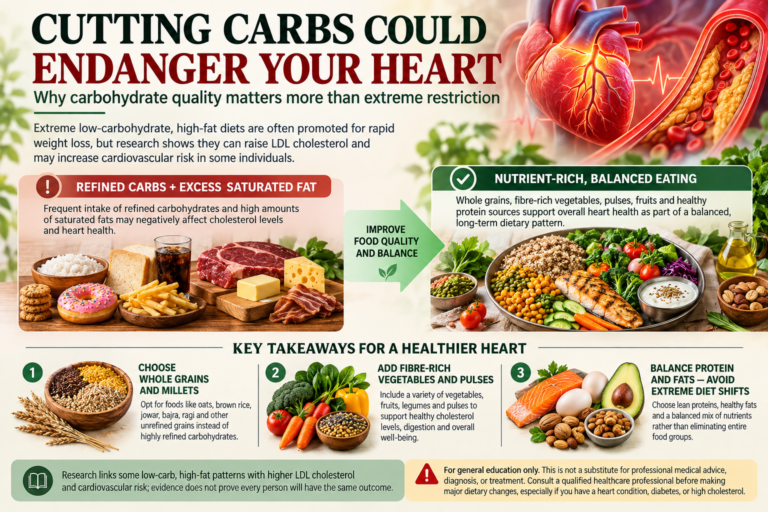
Cutting Carbs Could Endanger Your Heart and Health

When a healthy 51-year-old man decided to lose a few pounds, he chose a path millions of people around the…

Whatsapp Icon
Call Us WhatsApp Us