

Mind Your Mouth
The performance boost many people attribute to a daily shot of beetroot juice does not depend solely on what is…
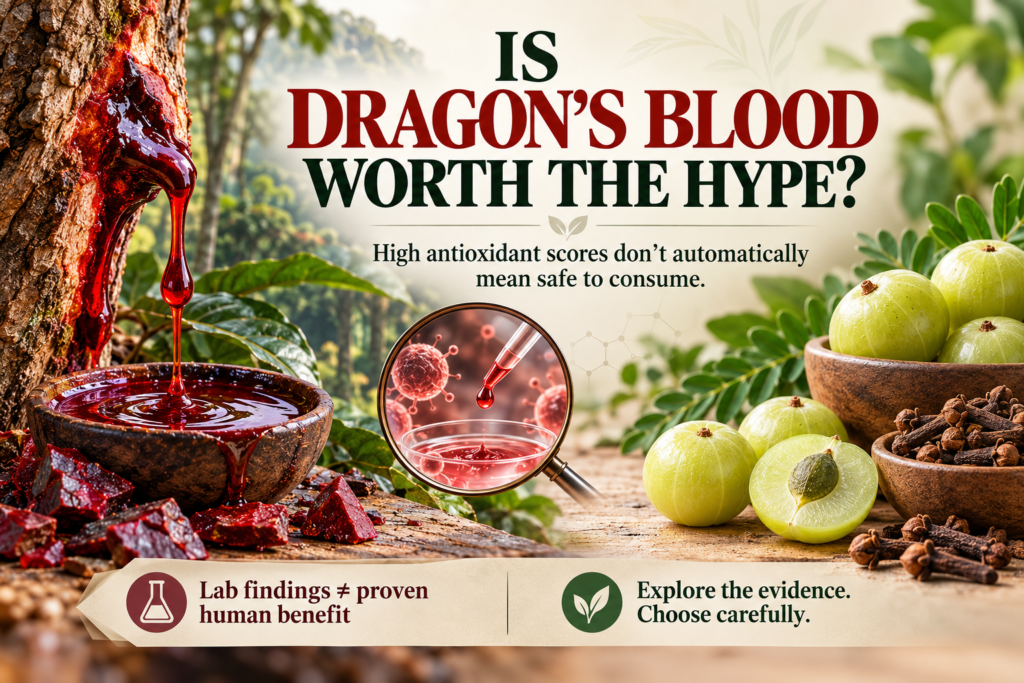
When researchers evaluated the total antioxidant levels of thousands of foods and botanical substances, a little-known Amazonian tree sap, rather than a common fruit or vegetable, surfaced near the very top of the measurement charts. Known as sangre de grado, or dragon’s blood, this deep red latex extract has generated significant online buzz for its dramatic laboratory numbers.
At first glance, these laboratory scores suggest a revolutionary superfood. However, a deeper examination of the published evidence reveals a far more complex picture. Between corporate-sponsored cell research, mixed findings regarding potential cell toxicity, and the crucial distinction between laboratory assays and human nutrition, dragon’s blood serves as a primary case study in why impressive test-tube data does not automatically equal a sound dietary choice. Fortunately for readers seeking powerful antioxidant support, a well-evidenced, safer, and locally accessible alternative is already sitting in the traditional Indian pantry.
Disclaimer
This article discusses laboratory and cell-based research for general educational purposes only. It is not medical advice and does not recommend using dragon’s blood sap, any plant extract, or any dietary supplement for self-treatment. Always consult a qualified medical doctor before using any herbal product, particularly an imported or novel botanical extract.
To understand the interest surrounding dragon’s blood, it helps to look at broader surveys of global food items evaluated for total antioxidant capacity. In large-scale screening studies, common culinary spices like ground cloves frequently rank among the highest of all tested whole foods. Depending on the specific dataset and measurement assay used, ground cloves can show an antioxidant density roughly in the order of 100 times that of a typical fresh blueberry serving on a gram-for-gram basis. Whole fruits like amla (Indian gooseberry) also rank exceptionally high on these global comparisons.
Dragon’s blood sap is not a conventional dietary food at all. It was included in comprehensive botanical surveys alongside traditional herbs and medicinal plants. When subjected to standard laboratory assays such as Oxygen Radical Absorbance Capacity (ORAC) testing, raw dragon’s blood sap demonstrated values that eclipsed even high-scoring spices and berries. These striking laboratory figures quickly made their way into wellness headlines, sparking claims that the Amazonian sap might be the ultimate antioxidant discovery. Yet laboratory density alone tells only a small part of the story.
Dragon’s blood is a thick, dark red latex obtained by tapping the bark of Croton lechleri, a tall tree native to the Amazonian rainforests of South America. When the bark is cut, the tree exudes a viscous, bright red sap that quickly dries into a resinous coating.
For centuries, indigenous communities across South America have utilized Croton lechleri latex in traditional medicine. Historically, its primary applications have been topical and acute, used to seal external skin wounds, stop bleeding, soothe insect bites, or treat episodic digestive discomfort. It was never cultivated, harvested, or consumed as a daily food, a dietary berry, or an ongoing nutritional supplement. Recognizing its traditional background as a topical and acute medicinal latex is essential when evaluating modern claims that market the sap as an everyday wellness extract.
Modern scientific interest in Croton lechleri has produced several notable laboratory and cell-based studies. While these preliminary results highlight interesting biological activity, they must be interpreted within their precise scientific context.
One of the most frequently cited findings involves joint health research conducted by investigators affiliated with Case Western Reserve University and Albany Medical College. In a laboratory setting, researchers tested human knee cartilage explants obtained from joint replacement surgeries. When these cartilage tissues were exposed to inflammatory compounds, they began to degrade rapidly. Adding a specific, standardized Croton lechleri extract slowed this tissue breakdown and suppressed inflammatory signaling.
It is important to evaluate these findings alongside their funding context. This specific cartilage study was published in the Journal of Inflammation in 2007 (Gupta et al.) and evaluated a proprietary extract commercially marketed under the name “Progrado.” The research received direct financial support from the commercial manufacturer marketing the ingredient. While commercial funding does not invalidate scientific findings, transparent scientific reporting requires noting this financial relationship alongside the results, as corporate sponsorship is an important factor when weighing preliminary claims.
Other laboratory experiments have explored how the sap interacts with isolated cell lines and plant models. In test-tube studies involving gastrointestinal cancer cell lines, whole sap extracts were observed to induce apoptosis (programmed cell death) in the cultured cancer cells. Separately, in agricultural experiments using corn seedlings exposed to toxic chemicals, the extract appeared to blunt certain forms of genotoxic (DNA-damaging) stress.
Both of these findings represent early-stage, cell-level or plant-level laboratory observations. Observing that a concentrated plant latex causes cell death in a Petri dish or protects a seedling in a controlled experiment does not mean the raw sap can safely prevent or treat disease in human beings.
While high antioxidant scores and laboratory explant data generate positive headlines, safety evaluations present a far more complicated picture.
A central question in toxicological research is whether a substance possesses mutagenic potential—that is, whether it can cause genetic mutations in cellular DNA. The evidence surrounding Croton lechleri sap is complex and mixed rather than settled.
On one side, an independent toxicological study published by Lopes et al. (2004) in the Journal of Ethnopharmacology evaluated raw Croton lechleri sap using standard biological screening models. The researchers observed mutagenic activity in specific bacterial test strains (such as Salmonella typhimurium TA98 and TA100) and yeast models under defined concentration conditions.
Conversely, other independent laboratory evaluations testing different extractions of Croton lechleri on similar bacterial strains reported no detectable mutagenic activity. Because different studies using varied extraction methods and concentrations have reached opposing conclusions, the scientific literature presents a genuine open question regarding the sap’s safety profile. The safety of raw dragon’s blood sap cannot be described as definitively proven or settled in either direction.
For everyday wellness consumers, mixed mutagenicity data represents a clear stop sign. When evaluating an exotic plant material that has no historical precedent as a daily human food, conflicting evidence regarding cellular genetic toxicity indicates that regular, unmonitored internal consumption carries unquantified risks. High test-tube antioxidant capacity does not override fundamental questions about long-term cellular safety.
To fully understand dragon’s blood, one must distinguish between raw, unrefined tree sap and purified, regulated pharmaceutical medications derived from the plant.
A specific purified compound isolated from Croton lechleri latex, known generically as crofelemer, was evaluated through controlled clinical trials and received approval from the US Food and Drug Administration (FDA) under the brand name Fulyzaq (now Mytesi). However, this approval is extremely narrow: crofelemer is indicated solely as a prescription drug to relieve noninfectious diarrhea in adult HIV/AIDS patients receiving antiretroviral therapy.
Crofelemer functions as an antisecretory agent in the gastrointestinal tract, working locally in the gut without being absorbed significantly into the bloodstream. This clinical application is entirely distinct from buying raw Amazonian sap or commercial liquid drops online as a general wellness supplement. The existence of a highly purified, single-indication prescription medication derived from a plant does not validate consuming raw, unstandardized whole sap extracts for general health.
Questions regarding raw botanical safety, quality control, and potential risks are not unique to imported South American saps. Similar safety considerations apply to traditional herbal formulations closer to home, including multi-herb Ayurvedic preparations like triphala.
Comprehensive analytical surveys of commercially available Ayurvedic herbal products have periodically identified heavy metal contamination. Research published in major medical journals, such as a survey by Saper et al. in JAMA, found that a notable percentage of tested over-the-counter herbal products contained detectable levels of lead, mercury, or arsenic exceeding established safety thresholds. Some multi-herb formulations, including certain commercial triphala batches, were included among those flagged for heavy metal content.
At the same time, separate independent quality assays evaluating specific, high-quality amla and triphala products have found zero detectable heavy metal residues. Both realities exist simultaneously: heavy metal contamination is not an inherent trait of amla or triphala as plant species, but rather a direct reflection of manufacturing practices, soil conditions, sourcing, and post-harvest quality control. Consumers should recognize that safety depends on verified sourcing and rigorous third-party batch testing, regardless of where an herb originates. Food safety and regulatory oversight are also important considerations when evaluating products sold for consumption.
When comparing antioxidant options, amla (Indian gooseberry, Emblica officinalis) stands out as an exceptionally strong candidate for daily health.
| Feature | Dragon’s Blood (Croton lechleri) | Amla (Emblica officinalis) |
| Primary Category | Medicinal tree latex / extract | Dietary whole fruit |
| Traditional Use | Topical wound healing, acute gut issues | Culinary food, daily dietary tonic |
| Antioxidant Profile | Extremely high in test tubes | Ranks among the highest whole foods globally |
| Cellular Safety Data | Mixed mutagenicity findings in lab studies | Long track record of safe food consumption |
| Regulatory Status in India | Unapproved / Novel imported ingredient | Fully recognized food & traditional ingredient |
| Accessibility & Cost | Expensive, imported, variable quality | Abundant, affordable, locally grown |
Amla ranks near the very top of standard food antioxidant assays globally, placing close to powerful spices like cloves and far ahead of typical cultivated fruits. Unlike dragon’s blood, amla is a genuine dietary whole food that has been eaten fresh, consumed as juice, cooked into traditional dishes, and consumed daily across India for centuries. It presents no mutagenicity concerns and offers well-documented biological activity alongside a long history of safe human dietary use.
Rather than pursuing expensive, unverified Amazonian sap extracts with unresolved safety questions, choosing quality-checked, locally sourced amla provides superior, reliable antioxidant support.
In India, the importation and commercial sale of novel botanical extracts are strictly regulated by the Food Safety and Standards Authority of India (FSSAI) in coordination with the Ministry of Ayush.
Under FSSAI regulations, any plant material or botanical extract that lacks a documented history of safe food consumption within India is classified as a “novel food” or specialized ingredient. Bringing such novel ingredients into the Indian retail market requires comprehensive safety documentation, including detailed toxicological profiles, standardized processing disclosures, and formal approval prior to commercial distribution.
Because raw dragon’s blood sap lacks a history of dietary use in India and carries unresolved safety questions in international research, it has not received broad clearance as an over-the-counter dietary food ingredient. This regulatory framework serves an important consumer protection role, ensuring that exotic medicinal extracts cannot simply be marketed as everyday food items without thorough safety evaluation.
No, raw dragon’s blood sap is not recommended for internal dietary use. Laboratory studies on its cellular safety have yielded mixed results, with some tests showing potential mutagenic activity under specific conditions. Furthermore, it has no history of use as an everyday food item.
Ground cloves contain an extraordinarily concentrated amount of polyphenolic compounds, particularly eugenol. In standardized dry-weight laboratory assays (such as ORAC tests), dried herbs and spices like cloves concentrate these protective phytochemicals far more densely than fresh, water-rich fruits.
While raw dragon’s blood sap scores extremely high in isolated test-tube assays, amla is one of the densest whole-food antioxidant sources available globally. More importantly, amla delivers its antioxidant benefits as a safe, time-tested whole food without the toxicity concerns associated with novel tree latex extracts.
No. Crofelemer is a specific, purified chemical compound isolated from the sap that has been approved by the US FDA as a prescription-only drug for a single condition: noninfectious diarrhea in HIV/AIDS patients on antiretroviral therapy. Buying raw imported sap or liquid extracts online is completely different from taking a purified, medically supervised prescription drug.

The performance boost many people attribute to a daily shot of beetroot juice does not depend solely on what is…
When a healthy 51-year-old man decided to lose a few pounds, he chose a path millions of people around the…
When it comes to vitamin B12, the biggest obstacle to maintaining healthy levels is rarely how much you consume. The…
