
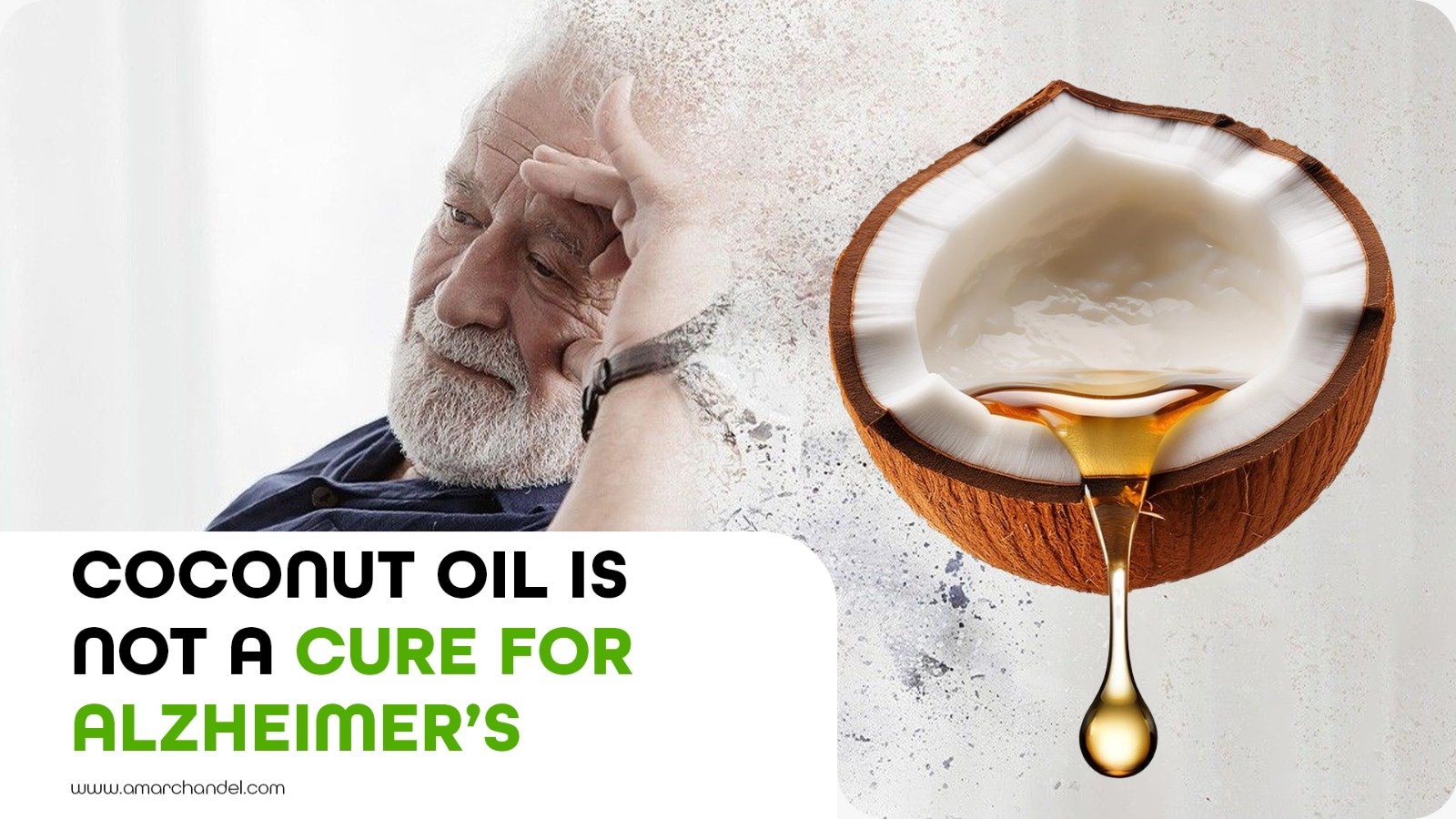
In recent years, coconut oil has been promoted as a “superfood” with almost magical benefits. From weight loss to heart health—and even claims of curing Alzheimer’s disease—the hype has been strong, especially on social media and wellness blogs.
But what does science actually say?
The idea that coconut oil might help Alzheimer’s disease is based on a simple theory.
In Alzheimer’s, brain cells struggle to use glucose (sugar) for energy. Some researchers suggested that ketones—an alternative fuel for the brain—might help. Coconut oil contains medium-chain fatty acids (MCFAs), which the body can convert into ketones.
This led to the belief that coconut oil could “feed the brain” and improve memory.
Sounds promising—but theory is not the same as proof.
The main scientific study often cited is on a compound called AC-1202, a concentrated form of these fatty acids, not coconut oil itself.
Early results showed a small improvement in memory in some patients. But by the end of the study, the benefits disappeared. Even in the subgroup where it initially seemed helpful, later analysis showed no consistent effect.
Importantly:
This was not a study on coconut oil, and the results were not strong or lasting. So far, no high-quality clinical trials have shown that coconut oil improves or cures Alzheimer’s disease.
Major health organisations are clear on this.
The Alzheimer’s Association states:
“There is no scientific evidence that coconut oil helps treat or prevent Alzheimer’s disease.”
Similarly, global reviews emphasise that while ketone-based therapies are being studied, dietary coconut oil has not been proven effective.
Coconut oil is deeply rooted in Indian culture, especially in South India, where it has been used for cooking and traditional remedies for generations.
Because of this familiarity, people often assume:
• Natural = safe
• Traditional = scientifically proven
But these are not always the same.
The internet has amplified anecdotal stories—individual cases where someone claimed improvement. While such stories are powerful, they are not reliable scientific evidence.
Here’s another important point
Coconut oil is high in saturated fat, which is known to raise LDL (bad cholesterol) levels.
The World Health Organization (WHO) and other global bodies recommend limiting saturated fat intake to reduce the risk of heart disease.
Since heart health and brain health are closely linked, anything that harms blood vessels may also affect brain function over time.
In India, Alzheimer’s and dementia cases are rising due to:
• Longer life expectancy
• Lifestyle changes
• Increasing diabetes and heart disease
Instead of focusing on one “miracle food,” experts recommend a broader approach.
Diet patterns that support brain health include:
• Plenty of fruits and vegetables
• Whole grains like millets and brown rice
• Nuts and seeds
• Limited saturated fats and processed foods
Simple Indian foods like dal, sabzi, seasonal fruits, and nuts already provide many of these benefits.
Let’s be clear:
• Coconut oil is not a cure for Alzheimer’s
• There is no strong evidence it improves memory
• Claims of reversal are not supported by science
That doesn’t mean coconut oil is “bad” in small amounts. It can be used occasionally as part of a balanced diet. But relying on it as a treatment is misleading.
Research consistently points to lifestyle factors that matter much more:
• Regular physical activity
• Balanced diet rich in plant foods
• Good sleep
• Mental stimulation
• Control of diabetes, blood pressure, and cholesterol
These have far stronger evidence than any single food.
It’s natural to hope for simple solutions to complex diseases like Alzheimer’s. But science rarely works that way.
Coconut oil may be useful in cooking or traditional practices, but when it comes to brain health, the evidence simply isn’t there.
Instead of chasing miracle cures, the real power lies in consistent, everyday habits that protect the brain over time.
References
1. Alzheimer’s Association. Coconut oil and Alzheimer’s disease—evidence review.
2. Review articles on ketone-based therapies and dementia (e.g., Neurobiology of Aging, Alzheimer’s Research & Therapy).
3. World Health Organization (WHO). Guidelines on saturated fat intake and health.
4. American Heart Association (AHA). Dietary fats and cardiovascular risk.