
The Simple Mealtime Trick to Maximise Your Vitamin D Absorption
Few health routines feel more frustrating than diligently taking a prescribed vitamin D supplement for months, only to return to…
When sports scientists first suggested that drinking plain beetroot juice could help athletes ride faster and last longer, the idea sounded almost too simple to take seriously. Endurance sport is crowded with expensive powders, synthetic stimulants, and bold claims, so a humble root vegetable offering measurable physical advantages met plenty of early scepticism.
Rather than dismissing the notion, researchers put beetroot juice through rigorous, placebo-controlled laboratory and field testing. Over the past fifteen years, dozens of clinical trials and systematic reviews have examined how dietary nitrate affects oxygen use, muscle endurance, and recovery. The results are genuinely intriguing, though far more nuanced than marketing labels suggest.
In this article, we look closely at what controlled trials actually proved, where the science remains unsettled, who stands to benefit most, how much nitrate makes a difference, and what Indian runners, cyclists, and gym-goers should know about choosing and using beetroot products safely. Dietary nitrate is also connected to the body’s nitric oxide pathway, which plays an important role in blood vessel function and cardiovascular health. You can explore this relationship further in our guide to nitric oxide and heart health.
Disclaimer: This article is for general educational purposes and is not medical or sports advice. Beetroot juice can lower blood pressure and is high in oxalate. Speak to your doctor before using concentrated beetroot products if you take blood pressure medicines, have kidney stones or kidney disease, have diabetes, or are pregnant. Competitive athletes should check their sport’s rules.
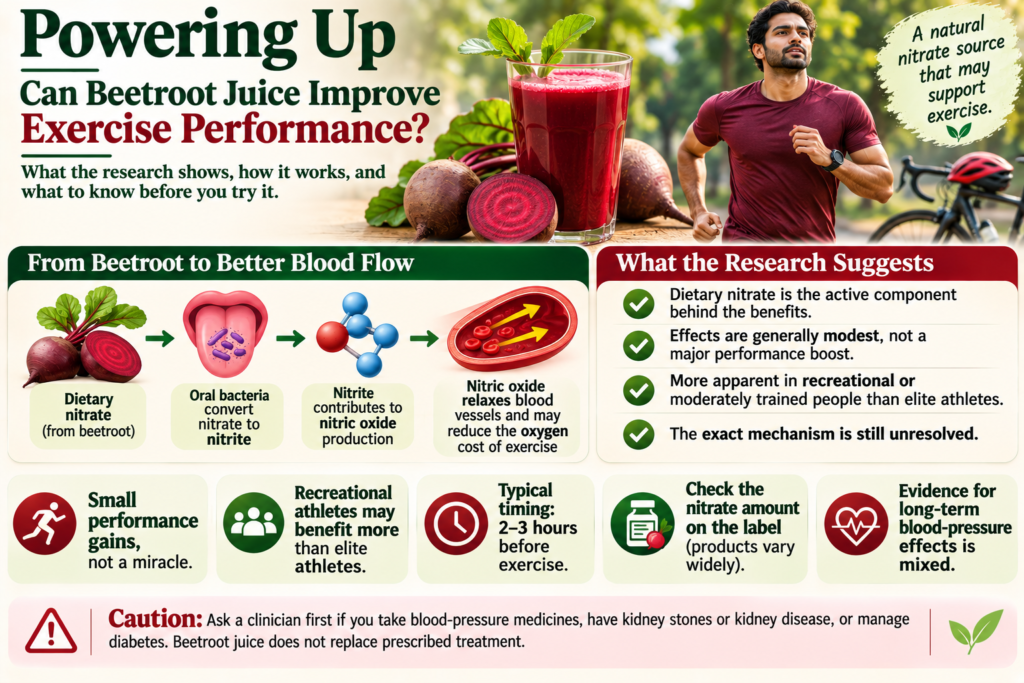
To understand why beetroot attracts attention in sports nutrition, it helps to look at a single naturally occurring compound: inorganic nitrate. While beetroot also contains antioxidants and pigments called betalains, controlled experiments using nitrate-depleted beetroot juice as a placebo show no improvement in exercise economy. That distinction confirms that nitrate, rather than beetroot’s general antioxidant profile, is the active driver behind its performance effects.
Once you drink beetroot juice, your body processes that nitrate through a specific multi-step pathway:
Nitric oxide acts as a signaling molecule that relaxes and widens blood vessels, improving blood flow to active muscle tissue. More importantly, it appears to reduce the oxygen cost of exercise, meaning your muscles require slightly less oxygen to sustain a given pace or power output. Because oral bacteria play an essential role in the second step, using strong antibacterial mouthwash can blunt this conversion and reduce the physiological response.
Early laboratory observations showing lower oxygen demand during cycling prompted researchers to test whether those physiological shifts translated into faster real-world race times.
A landmark study published in Medicine & Science in Sports & Exercise in 2011 by Lansley and colleagues moved beetroot research from treadmill efficiency tests onto simulated road courses. Nine club-level male cyclists completed a randomised, double-blind crossover trial. Roughly 2.5 hours before performing time trials, each rider drank 0.5 litres of either standard beetroot juice providing about 6.2 mmol of nitrate or a specially prepared nitrate-depleted beetroot juice placebo that looked and tasted identical.
The results showed modest, measurable improvements across both distances. On the 4 km time trial, cyclists finished 2.8% faster on average (improving from 6.45 minutes to 6.27 minutes). On the 16.1 km trial, times improved by 2.7% (dropping from 27.7 minutes to 26.9 minutes), with riders generating higher power output for the same rate of oxygen uptake. While well-controlled, the study had clear boundaries: it involved just nine participants, all male and competing at a club rather than elite level, across a single acute test.
For several years, researchers believed dietary nitrate worked primarily by making mitochondria, the energy-producing structures inside muscle cells, operate more efficiently. That explanation stemmed from a 2011 study in Cell Metabolism by Larsen and colleagues, which found that supplementing with pure sodium nitrate improved mitochondrial efficiency in human muscle biopsies.
However, subsequent testing with actual beetroot juice challenged that conclusion. In a 2016 study published in the Journal of Physiology, Whitfield and colleagues gave 10 young active men 280 mL of concentrated beetroot juice daily (providing roughly 26 mmol of nitrate) for seven days. While whole-body oxygen consumption dropped by about 3% during submaximal exercise, direct analysis of muscle tissue biopsies revealed no change in markers of mitochondrial efficiency. A 2020 investigation similarly failed to observe mitochondrial changes following nitrate or nitrite intake. Scientists now view the exact cellular mechanism as unresolved, with current research pointing toward reduced adenosine triphosphate (ATP) cost during muscle contraction rather than changes inside the mitochondria themselves.
As individual trials multiplied, sports scientists pooled the findings into larger systematic reviews to separate genuine performance gains from statistical noise.
A comprehensive umbrella review published in Nutrients in June 2025 synthesized evidence from 15 separate meta-analyses evaluating beetroot juice in healthy adults and athletes. The authors reported a small positive effect on time to exhaustion (a standardised mean difference of 0.25) and a negligible effect on maximal oxygen uptake, or VO2max (0.16).
Subgroup patterns offered useful practical context. Non-athletes and recreational exercisers experienced slightly better gains in aerobic endurance (standardised mean difference of 0.26), whereas trained professional athletes saw modest improvements primarily in muscular strength measures (0.27). Across the pooled analyses, benefits appeared most consistently when nitrate was taken two to three hours prior to exercise or consumed daily across three or more days. Overall, the review emphasized that effect sizes are small rather than transformative.
Adding further granularity, a 2026 systematic review and meta-analysis by Cai and colleagues in Frontiers in Nutrition analyzed 33 randomized controlled trials examining aerobic and anaerobic exercise outcomes, including VO2max, high-intensity sprint performance, and mean power output. The pooled data suggested modest support for specific high-intensity and power metrics under targeted dosing protocols, though the analysis noted limitations due to small sample sizes and relatively few trials within several athletic subgroups.
Across the clinical literature, training status strongly influences how much an athlete gains. Moderately trained runners, weekend cyclists, and recreational gym-goers typically respond more noticeably than highly conditioned elite competitors. For example, a 2014 trial by Boorsma and colleagues testing elite 1,500-metre runners found no meaningful improvement in race times following beetroot supplementation. A 2017 study of trained distance runners similarly found slight improvements in shorter 1,500-metre efforts but no benefit over 10,000 metres. A 2025 scientific review notes that individuals with exceptional baseline aerobic fitness (VO2max above 65 mL/kg/min) generally show minimal response, likely because their natural nitric oxide production and vascular efficiency are already highly adapted.
Getting any measurable benefit from beetroot depends heavily on consuming enough actual nitrate at the right time. Dose-response research led by Wylie and colleagues in 2013, and summarized in subsequent physiological reviews, established clear thresholds for active adults:
Individual responses vary substantially based on baseline diet, oral microbiome health, and fitness level, so results observed in one trial cannot be assumed for every athlete or product.
Walk into a sports nutrition store or browse Indian e-commerce platforms today, and you will find raw beetroot powders, concentrated shots, capsules, and fruit blends. Navigating these choices requires looking closely at actual nitrate delivery rather than front-label promises.
Natural nitrate levels in beetroot fluctuate dramatically depending on soil quality, fertilizer use, cultivar, and harvest timing. Commercial supplements show even wider discrepancies. In December 2025, independent testing by ConsumerLab evaluated commercial beetroot juices, powders, and chews, revealing a more than 200-fold variation in nitrate content, ranging from roughly 2 mg to nearly 496 mg per serving. Concentrated shots came closest to clinical trial doses at around 500 mg per bottle, standard juices provided roughly 200 mg to 300 mg per cup, and gummy chews contained negligible amounts.
While concentrated shots are often marketed as making standardized dosing effortless, that advantage holds true only if the manufacturer explicitly tests and prints the exact milligram or millimole nitrate content per serving on the nutrition panel. Comparable independent laboratory audits of Indian supplement brands are not publicly available, making label transparency essential. If a powder or shot lists only “beetroot extract” without specifying standardized nitrate content, you have no reliable way to know whether you are getting an effective dose.
Across India’s growing running, cycling, and strength-training communities, interest in natural ergogenic aids has expanded alongside wider availability of locally packaged beetroot powders and concentrated shots. Some Indian endurance athletes and coaches incorporate fresh beetroot juice or commercial nitrate shots into pre-event routines, particularly ahead of half-marathons or hot-weather cycling events. However, because fresh home-juiced beetroot varies in concentration and requires drinking 300 mL to 500 mL of liquid before activity, athletes experimenting with local produce should test tolerance during regular training runs rather than on race morning.
Outside athletic circles, beetroot juice is frequently discussed for its potential role in supporting cardiovascular health. Because nitric oxide helps relax blood vessel walls, researchers have investigated whether regular dietary nitrate intake lowers resting blood pressure.
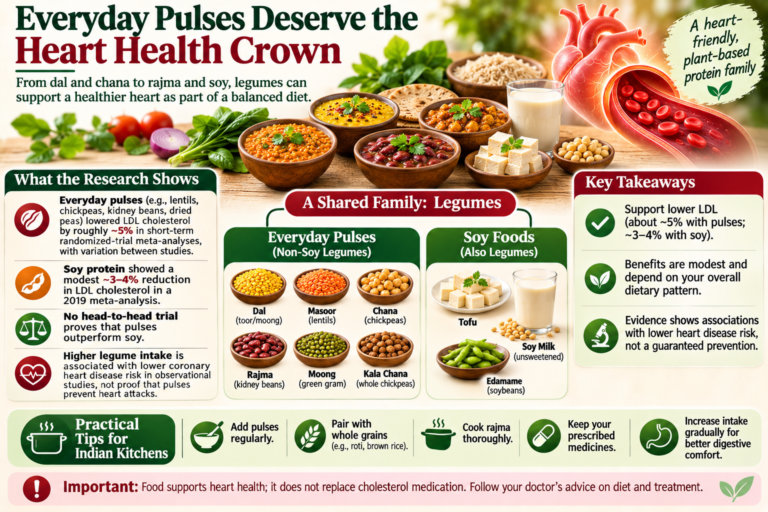
Clinical trials in this area have produced mixed findings. Several short-term studies report modest reductions in systolic blood pressure among adults with normal or mildly elevated readings, while other longer trials find little to no sustained effect, particularly in individuals already taking blood pressure medications. While incorporating nitrate-rich vegetables like beetroot, spinach, and leafy greens into daily meals supports overall heart health, beetroot juice is not a substitute for prescribed antihypertensive treatment or medical care. A balanced plant-rich diet can also include other fibre-rich foods such as lentils, chickpeas and everyday pulses that support heart health.
Although beetroot is an everyday vegetable, concentrated juices and commercial shots deliver high doses of bioactive compounds that require caution for certain groups:
Exercise performance also depends on healthy respiratory function, especially during endurance activities. For more background, read how to keep your lungs healthy.
Drink beetroot juice or a standardized nitrate shot roughly two to three hours before your workout or race. This window allows oral bacteria and digestive processes enough time to convert dietary nitrate into peak circulating nitrite levels.
Neither form is inherently superior; what matters is the total nitrate dose delivered. Concentrated shots require drinking less liquid before running, which reduces stomach discomfort, provided the label verifies a nitrate dose around 300 mg to 500 mg. Fresh juice works well if you tolerate larger fluid volumes.
No. While dietary nitrate may produce modest, temporary reductions in blood pressure for some individuals, study results are inconsistent. Never stop or reduce prescribed blood pressure medication in favor of beetroot juice without direct medical supervision.
For most healthy adults, moderate daily intake is safe, though it may turn urine or stools pink. However, daily concentrated juice is not recommended for people prone to oxalate kidney stones, individuals with low blood pressure, or those managing diabetes without medical guidance.
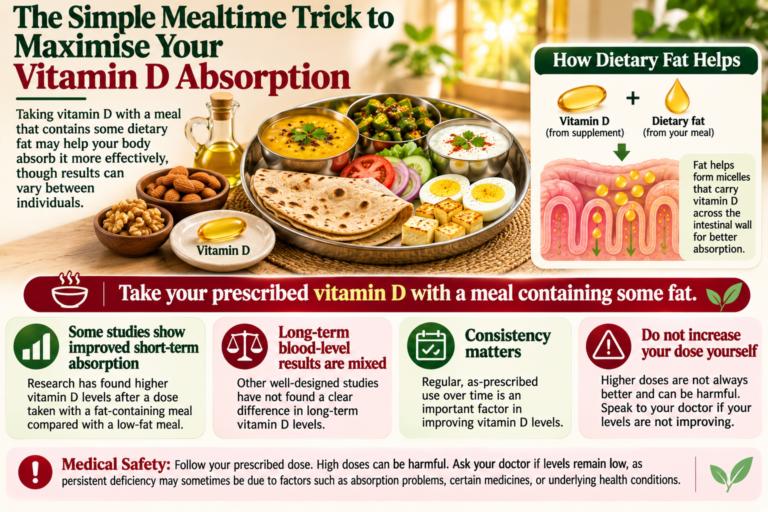
Few health routines feel more frustrating than diligently taking a prescribed vitamin D supplement for months, only to return to…
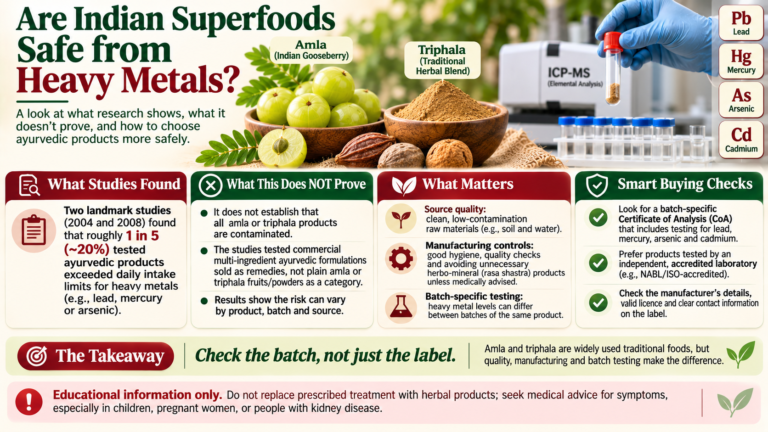
For generations, amla and triphala have held a trusted place in Indian kitchens and medicine cabinets. Whether taken as a…
For nearly two decades, one legume enjoyed a rare privilege in American nutrition: an official government-backed health claim linking it…
