

Are Indian Superfoods Safe from Heavy Metals?
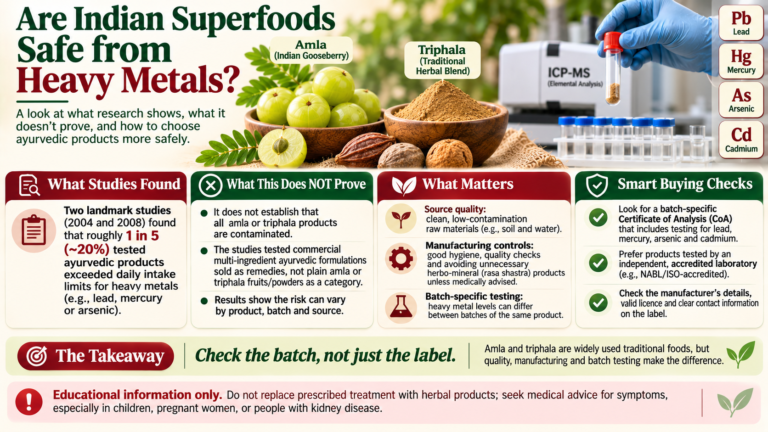
For generations, amla and triphala have held a trusted place in Indian kitchens and medicine cabinets. Whether taken as a…
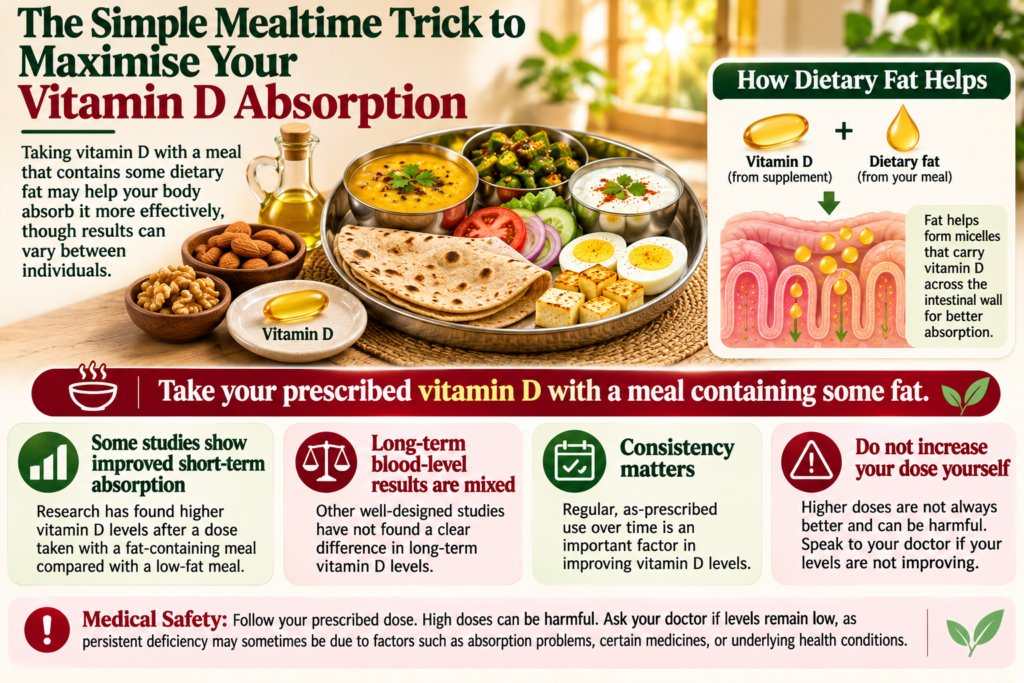
Few health routines feel more frustrating than diligently taking a prescribed vitamin D supplement for months, only to return to the lab and discover that your blood levels have barely moved. Across India, millions of adults swallow weekly 60,000 IU sachets or daily tablets, expecting a straightforward fix for fatigue, bone aches, or a low lab report, yet repeat tests frequently fall short of normal targets.
Often, the issue is not the supplement itself, but how it is taken. Because vitamin D is fat-soluble, swallowing a capsule with a glass of plain water on an empty stomach may limit how much your body actually takes in. Pairing your dose with a meal that contains dietary fat is a simple, low-cost habit that may help your body absorb the nutrient more effectively.
In this article, we explore why blood levels sometimes stall, what clinical studies actually show about taking vitamin D with food, what Indian diagnostic data reveal about deficiency trends, and when persistently low levels point to an underlying medical issue that requires a doctor’s evaluation. Understanding the role of a balanced diet is equally important, including the benefits of everyday vegetables that help support the body’s natural defences.
Disclaimer: This article is for general educational purposes and is not medical advice. Do not change the dose or schedule of a prescribed vitamin D supplement without speaking to your doctor. Very high doses can be harmful. If your vitamin D level is not rising, see a doctor to look for other causes rather than increasing the dose yourself.
When two people take the exact same dose of vitamin D, their resulting blood levels can look very different. Biological response to supplementation varies substantially from person to person, and dietary fat is only one piece of a much larger puzzle.
A comprehensive 2015 scientific review published in Nutrients by Mazahery and von Hurst evaluated dozens of variables influencing how blood concentrations of 25-hydroxyvitamin D, or 25(OH)D, respond to supplements. The researchers concluded that the most consistent determinants of a person’s response are their starting baseline level, body weight and body fat percentage, the total dose administered, and the chemical form of the supplement (vitamin D3 generally raises levels more reliably than vitamin D2). Beyond those core drivers, the exact impact of secondary factors remains less certain.
Other everyday barriers frequently get in the way of a good lab result. Simply forgetting weekly doses breaks consistency. Certain digestive conditions reduce nutrient uptake in the small intestine, while specific medications accelerate how quickly the liver breaks down vitamin D. Taking your pill with food can support absorption, but it works alongside these broader biological realities rather than overriding them. Digestive health also plays a role in nutrient uptake, as explained in this article about the overlooked connection between childhood constipation and cow’s milk.
The advice to take vitamin D with food stems from basic physiology: fat-soluble vitamins dissolve in lipids and rely on dietary fat to trigger bile release and form micelles, the microscopic droplets that carry nutrients across the intestinal wall. However, human clinical trials testing this mechanism have produced mixed, nuanced results.
One of the most widely cited observations comes from a 2010 report in the Journal of Bone and Mineral Research by Mulligan and Licata at the Cleveland Clinic. The researchers tracked 17 patients whose vitamin D blood levels had failed to rise despite ongoing supplementation. Instead of changing their doses, the doctors instructed these patients to take their existing supplement with the largest meal of the day.
After two to three months, average serum 25(OH)D levels increased by roughly 56% (often summarized in media reports as “over 50%”). While encouraging, this study had notable limitations: it involved only 17 participants, had no control group for comparison, and included some patients with underlying malabsorption conditions. Furthermore, the researchers could not separate the physiological effect of meal timing from improved consistency in taking the pills.
A more controlled experiment conducted at Tufts University by Dawson-Hughes et al. and published in the Journal of the Academy of Nutrition and Dietetics in 2015 examined absorption directly. Fifty healthy adults aged 50 and older were given a single 50,000 IU dose of vitamin D3 alongside either a fat-free breakfast or a breakfast containing 30% of its calories from fat.
Twelve hours after dosing, peak plasma vitamin D3 levels were 32% higher in the group that ate the fat-containing meal (with a 95% confidence interval of 11% to 52%). Interestingly, the ratio of monounsaturated to polyunsaturated fats made no difference to absorption. Readers should note two caveats: this study measured short-term vitamin D3 spikes after one large dose rather than long-term 25(OH)D storage levels, and the research was co-funded by Pfizer.
Other randomized trials complicate the picture, showing that more fat does not automatically guarantee better long-term outcomes:
Taken together, the science shows that taking vitamin D with a meal containing some fat is a sensible habit that may support absorption, even though long-term effects on blood levels vary across studies.
You do not need to overhaul your diet or eat heavy, greasy meals to give your supplement a better chance of working. A few simple adjustments fit easily into an Indian routine:
For additional dietary context, you can also explore how leafy greens and dietary nitrates contribute to heart health.
Despite abundant year-round sunshine across most of the subcontinent, low vitamin D status remains a frequent clinical finding in Indian diagnostic laboratories.
Large-scale diagnostic audits highlight how common low readings are among people getting tested. An analysis by Metropolis Healthcare examining over 22 lakh (2.2 million) vitamin D test results collected between 2019 and January 2025 found that 46.5% of tested individuals were deficient, while another 26% fell into the insufficient range. Combined, roughly 72.5%, or nearly three-quarters of those tested, had below-optimal levels. Teenagers recorded the highest deficiency rate at 66.9%, and South India showed the highest regional prevalence at 51.6%. Over the five-year period, national deficiency rates among tested samples edged down from about 51% in 2019–20 to 43% in 2023–24. A subsequent Metropolis update covering 11.6 lakh tests from January 2025 to May 2026 similarly found close to seven in ten tested individuals had deficient or suboptimal readings.
It is important to view these numbers in context. Diagnostic lab data reflect people who sought medical testing—often because they had symptoms or risk factors—rather than a random cross-section of the entire country. Broader population modeling yields more conservative estimates; for instance, a 2025 policy roadmap by ICRIER and the Anvka Foundation estimated that roughly one in five Indians across the general population is clinically vitamin D deficient.
Several overlapping lifestyle and biological factors explain why people living in a sunny climate frequently record low levels:
If you have been taking your supplement consistently with meals for three months and your repeat lab test still shows little improvement, changing your breakfast will not solve the problem. At that stage, a doctor should investigate underlying medical or physiological barriers:
Avoid ordering frequent repeat blood tests on your own; ask your doctor when re-testing makes clinical sense, which is typically after 8 to 12 weeks of consistent therapy.
When blood levels refuse to budge, it is tempting to buy over-the-counter high-dose capsules or take extra weekly sachets. However, unlike water-soluble vitamins such as vitamin C, excess vitamin D is not easily flushed out in urine. It accumulates in body tissues and can cause serious toxicity.
Vitamin D toxicity, known medically as hypervitaminosis D, is a documented clinical concern in India, largely driven by unsupervised mega-dosing. In a well-known clinical case series from the Delhi area published in Clinical Endocrinology, doctors evaluated 16 patients suffering from symptomatic vitamin D toxicity. Every single patient had received excessive cumulative doses (with a median total intake of 3.6 million IU) for nonspecific aches or fatigue. Patients presented with dangerously elevated blood calcium levels (hypercalcemia), severe dehydration, vomiting, constipation, and acute kidney injury.
For most healthy adults, medical authorities set the tolerable upper intake level at 4,000 IU per day unless higher short-term therapeutic doses are explicitly prescribed and monitored by a physician. Moreover, clinical guidelines from the Endocrine Society advise against routine high-dose supplementation or indiscriminate testing in healthy adults under age 75 who have no specific risk factors, emphasizing targeted treatment based on medical need. If pairing your supplement with a fat-containing meal improves absorption, that is all the more reason to stick strictly to your doctor’s prescribed dose and have your levels reviewed professionally rather than self-adjusting.
There is no strict biological rule favoring morning over evening. Because vitamin D remains in circulation for weeks, regular intake matters far more than the clock. Take it alongside whichever daily meal—breakfast, lunch, or dinner—contains some fat and fits most reliably into your routine.
Not necessarily. While an early 2010 clinic study instructed patients to use their largest meal, later controlled research shows that the presence of a moderate amount of dietary fat is what matters, rather than eating a heavy feast. A regular home-cooked meal with a little ghee, oil, curd, nuts, or eggs is sufficient.
Persistently low readings usually point to missed doses, taking dry granules with plain water instead of milk or food, higher body fat stores, gut absorption issues, or drug interactions. Speak to your doctor before taking another course of high-dose sachets so they can identify the root cause.
Yes. Full-fat or toned milk contains natural dairy fat that aids absorption, making it a convenient option, particularly for dispersible vitamin D granules or drops. If you use skimmed milk or plant-based milk, pair it with a snack containing nuts, seeds, or toast with butter or peanut butter.
For generations, amla and triphala have held a trusted place in Indian kitchens and medicine cabinets. Whether taken as a…
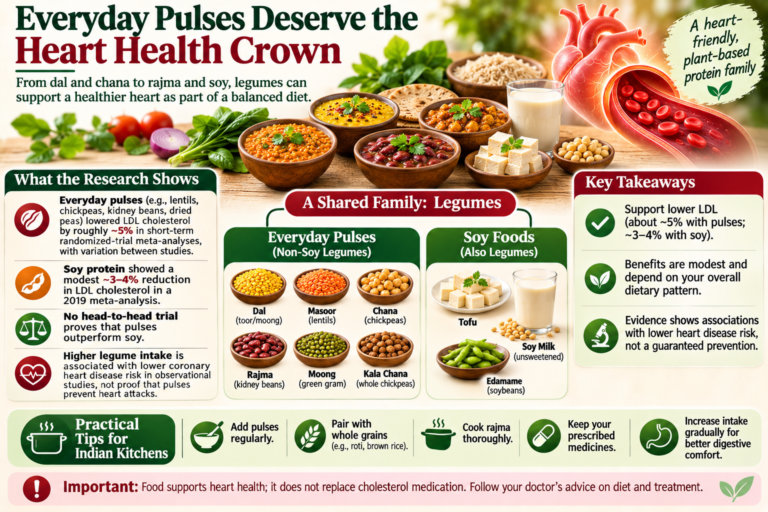
For nearly two decades, one legume enjoyed a rare privilege in American nutrition: an official government-backed health claim linking it…
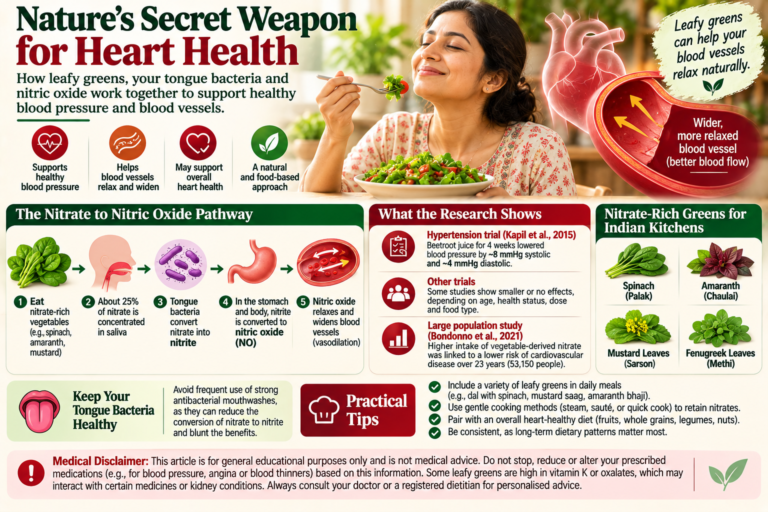
When we think of heart health, our minds usually jump to cutting back on salt, lacing up running shoes, or…
