
Everyday Pulses Deserve the Heart Health Crown
For nearly two decades, one legume enjoyed a rare privilege in American nutrition: an official government-backed health claim linking it…
For generations, amla and triphala have held a trusted place in Indian kitchens and medicine cabinets. Whether taken as a morning spoonful of churna, a daily shot of juice or a simple dried fruit, these staples are widely used to support digestion, immunity and antioxidant intake. Yet over the past two decades, recurring headlines about lead, mercury and arsenic in Ayurvedic formulations have left many health-conscious consumers uncertain. If traditional botanicals carry such a strong reputation for wellness, why do laboratory tests keep flagging toxic elements in commercial bottles?
Answering that question requires separating broad anxieties from specific evidence. In this article, we examine what major peer-reviewed studies actually found regarding heavy metals in Ayurvedic products, what those findings reveal (and fail to reveal) about amla and triphala specifically, and why manufacturing realities in India create distinct risks. Finally, we outline practical, verifiable steps you can take to reduce your exposure without relying on guesswork. Understanding wider sources of everyday chemical exposure can also help consumers make more informed choices, as explored in this guide to hidden chemicals in our kitchens.
Medical Disclaimer: This article is for general educational purposes and is not medical advice. Heavy metals can harm children, pregnant women and people with kidney disease. Do not stop a prescribed treatment in favour of herbal products. If you or a child has used herbal products and develop abdominal pain, constipation, unusual tiredness or numbness, see a doctor and mention the products.
Unlike beneficial dietary minerals such as iron, zinc or magnesium, toxic heavy metals serve no useful biological role in the human body. Lead, mercury, arsenic and cadmium are environmental and industrial contaminants that can enter the food and supplement chain through polluted soil, irrigation water or manufacturing practices. Once ingested, the body struggles to excrete them efficiently. Instead, they accumulate slowly in soft tissues, organs and bones over months or years of repeated exposure.
Chronic low-level intake can quietly disrupt vital systems before obvious symptoms appear. Lead interferes with blood cell formation, damages the kidneys and impairs the central nervous system. Mercury and arsenic similarly target neurological function, cardiovascular health and organ tissue, while cadmium is strongly linked to kidney toxicity and bone demineralisation.
Young children and developing foetuses face the greatest danger because their brains and nervous systems are still forming, and their bodies absorb a higher proportion of ingested metals than adults do. According to the World Health Organization, there is no known safe blood lead concentration; even minimal exposure can affect cognitive development and behaviour in children. The clinical consequences are well documented: medical literature has recorded more than 80 cases of lead poisoning linked to Ayurvedic medicines globally since 1978, underscoring why quality control is a genuine public health concern rather than a theoretical worry.
Environmental contaminants can enter homes and daily routines through more than one route. For broader context on reducing exposure, see how to avoid invisible pollutants in everyday environments.
Much of the public debate around heavy metals in Ayurvedic products traces back to two landmark investigations led by Dr Robert Saper and colleagues, published in the Journal of the American Medical Association (JAMA). Looking closely at what these studies measured helps clarify where the real risks lie.
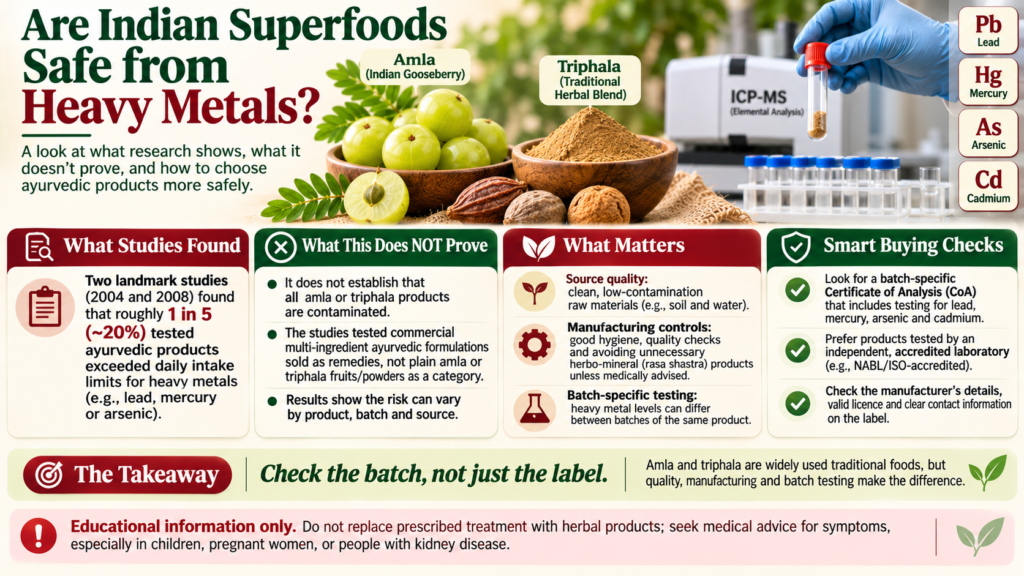
In 2004, Saper and his team analysed 70 commercially available Ayurvedic herbal medicine products manufactured in South Asia and purchased from retail stores in the Boston area. Using laboratory screening, the researchers found that 14 of the 70 products, or exactly 20%, contained heavy metals at concentrations that would exceed established regulatory intake standards if taken according to the manufacturers’ recommended doses. Specifically, 13 products contained lead, six contained mercury and six contained arsenic, with several formulations containing more than one toxic element.
To check whether contamination was a one-off batch anomaly, the researchers repurchased samples of products that had tested positive and negative. The follow-up results matched the initial findings: products that initially tested positive remained contaminated, while those that initially tested negative stayed negative. Crucially, however, these 70 items were finished multi-ingredient commercial formulations sold as remedies, not plain amla or triphala evaluated as a distinct food category.
Four years later, Saper’s team published a broader follow-up in JAMA (2008), testing 193 Ayurvedic medicines purchased via US-hosted websites in 2005. Overall, 20.7% of the tested products contained detectable lead, mercury or arsenic, and every single one of those contaminated products exceeded at least one regulatory standard for acceptable daily intake.
One of the study’s most striking findings challenged the assumption that Western manufacturing guarantees safety. US-manufactured products had a contamination rate of 21.7%, showing no statistically significant difference from Indian-manufactured products at 19.5%. Notably, 95% of all metal-containing products were sold through US-based websites, and three-quarters of the contaminated items even claimed Good Manufacturing Practices or heavy-metal testing on their labels.
The study also identified a sharp divide between formulation types. Products made according to rasa shastra, a traditional branch of Ayurveda that deliberately combines herbs with purified metals, minerals or gems, were more than twice as likely to contain heavy metals as purely herbal products (40.6% versus 17.1%). The authors estimated that some Indian-made rasa shastra preparations could result in daily lead or mercury intakes hundreds to many thousands of times above acceptable limits. Readers should keep two methodological limits in mind: the samples were purchased in 2005, and the researchers used X-ray fluorescence screening rather than newer trace-element techniques, though the core pattern remains instructive.
When shoppers read that one in five Ayurvedic products failed heavy-metal testing, their immediate question is whether everyday staples like amla (Phyllanthus emblica) and triphala fall into that high-risk group.
Honesty requires acknowledging a common misconception. Some wellness commentary has claimed that early Boston testing found no detectable heavy metals or pesticides in amla or triphala. That claim cannot be verified against the Boston JAMA studies, which evaluated finished commercial formulations and did not report clean-bill-of-health results for amla or triphala as a group. A separate 2011 study by Indian researchers Rao, Kumarmeena and Galib did analyse single raw samples of amla, haritaki and bibhitaki collected locally in Punjab, finding trace amounts of certain metals well below permissible limits and no detectable pesticide residues. However, testing four individual raw plant samples from one location cannot prove that every commercial jar on the market is clean.
Because plants absorb minerals and pollutants directly from the soil and water in which they grow, contamination is not determined by the botanical name on the label. Two jars of triphala can have entirely different chemical profiles depending on where the trees grew, how the fruit was harvested and dried, and whether equipment leached metals during grinding. Furthermore, triphala is a blend of three dried fruits: amla, haritaki (Terminalia chebula) and bibhitaki (Terminalia bellirica). Each fruit comes from a different tree, potentially harvested across different regions and supply chains, adding variables to the final powder.
It is often suggested that pure, single-ingredient amla powder carries a lower contamination risk than multi-herb blends like triphala. From a supply-chain perspective, that expectation is reasonable: fewer botanical ingredients mean fewer agricultural regions, fewer drying facilities and fewer opportunities for environmental cross-contamination.
Even so, this remains a logical inference rather than a proven rule backed by comparative market data. Neither the 2004 nor the 2008 JAMA studies demonstrated that single-herb powders are consistently cleaner than triphala. What the research clearly shows is that the highest-risk category by far is rasa shastra herbo-mineral preparations, rather than simple dried fruit powders.
When evaluating heavy metal risks in daily wellness routines, comparisons to everyday foods frequently surface online. For instance, some articles attempt to reassure consumers by comparing estimated mercury levels in a serving of triphala with the mercury found in a can of white tuna.
Such comparisons are rarely helpful and can easily mislead readers. First, independent testing, such as Consumer Reports’ analysis of canned tuna, shows that white albacore tuna averages around 0.427 parts per million (ppm) of mercury, translating to tens of micrograms per drained can rather than extreme figures sometimes circulated online. Second, mercury in fish exists primarily as organic methylmercury, whereas herbo-mineral Ayurvedic preparations typically contain inorganic mercury compounds, such as mercuric sulphide, which behave differently in the digestive tract and kidneys.
More importantly, comparing a daily supplement to an occasional seafood meal obscures the wide range of contamination found in real-world herbal testing. While an uncontaminated herbal powder may contain negligible trace elements, the 2008 JAMA study found that contaminated rasa shastra products carried a median mercury concentration of 20,800 micrograms per gram. Reassurance based on theoretical food comparisons is no substitute for verifying actual laboratory results on the specific batch you plan to consume.
For consumers living in India or purchasing Indian-made supplements, local agricultural, industrial and regulatory conditions shape the risk profile in distinct ways.
Heavy metals enter Indian herbal supply chains through several pathways. Environmental pollution is a primary driver: medicinal trees and herbs grown near industrial zones, highways or farms irrigated with untreated wastewater can accumulate lead, cadmium and chromium in their roots, leaves and fruits. Post-harvest handling adds further vulnerability, as herbs dried on open ground near dusty roads or milled using worn metallic machinery can pick up surface contaminants.
Market surveys of raw medicinal plants illustrate this environmental reality. For example, a 2018 study by researchers in Lucknow examining 20 raw medicinal herbs sold in local Uttar Pradesh markets without quality assurance found lead and chromium concentrations exceeding World Health Organization permissible limits, alongside pesticide residues. Beyond accidental environmental uptake, deliberate addition remains a factor in classical rasa shastra formulations, where processed metals like bhasmas are intentional therapeutic ingredients, as well as occasional cases of economic adulteration in unregulated supply chains. These risks are part of a wider environmental health issue, also discussed in the impact of industrial toxins on women’s health.
India does have formal regulatory standards governing toxic metals in traditional medicines. Both the Ayurvedic Pharmacopoeia of India (API) and the Ministry of AYUSH certification schemes establish maximum permissible limits for purely herbal formulations: 10 ppm for lead, 3 ppm for arsenic, 1 ppm for mercury and 0.3 ppm for cadmium. These thresholds align with international benchmarks for botanical raw materials and finished herbal products.
However, consumers often misunderstand how these rules are enforced. While Rule 161 of the Drugs and Cosmetics Rules mandates proper labelling and packaging details for Ayurveda, Siddha and Unani drugs, universal batch-by-batch third-party heavy metal testing is not automatically guaranteed for every domestic retail product. India made heavy metal testing mandatory for exported purely herbal Ayurveda, Siddha and Unani medicines effective from 1 January 2006. For products sold within India, quality seals such as the AYUSH Standard Mark and AYUSH Premium Mark operate as voluntary certification schemes administered through the Quality Council of India, requiring compliant manufacturers to meet strict contaminant limits.
Recent analytical testing of commercial Indian Ayurvedic products paints a mixed, nuanced picture rather than a uniform crisis. For instance, a 2024 Indian study analysing 36 market samples of two widely prescribed classical herbal decoctions using advanced mass spectrometry found that all 36 samples complied with Ayurvedic Pharmacopoeia limits for lead, arsenic, mercury and cadmium. Conversely, other academic investigations into raw market herbs and specialised herbo-mineral preparations continue to uncover samples that breach safety thresholds. Blanket claims that a fixed percentage of all Indian herbs are unsafe oversimplify a market where rigorous, compliant manufacturers operate alongside loosely regulated local suppliers.
Because you cannot see, smell or taste lead or arsenic in a jar of powder, protecting yourself depends on how you source and verify your products. Practical, evidence-led steps include:
Reducing exposure also means paying attention to the air and surroundings in which you live. For additional practical guidance, read how to keep your lungs healthy and reduce exposure to environmental pollutants.
Certain groups face heightened vulnerability to heavy metal toxicity and should exercise particular caution with concentrated herbal supplements. These include infants and young children, pregnant and breastfeeding women (as lead stored in maternal bones can be released into the bloodstream and cross the placenta), older adults and anyone with impaired kidney function, since the kidneys are central to filtering trace metals from the blood.
Because heavy metal accumulation happens gradually, early poisoning often mimics everyday health complaints. Recognised warning signs of lead and heavy metal toxicity include persistent abdominal pain, severe constipation, nausea, unusual fatigue, headaches, unexplained anaemia (pale skin and weakness) and tingling or numbness in the hands and feet. If you or a family member develop any of these symptoms while using Ayurvedic or herbal products, stop taking the supplement promptly and consult a doctor. A simple venous blood test can measure blood lead levels and guide appropriate medical care.
Is amla safe to eat every day?
Fresh whole amla fruit eaten as part of a balanced diet is widely consumed as a nutritious food. Concentrated amla powders or juices can vary in purity depending on soil quality and processing, so daily supplement users should choose brands that verify low heavy-metal levels through batch testing.
Is triphala contaminated with lead?
Triphala itself is simply a blend of three dried fruits and does not inherently contain lead. However, because it combines three plant ingredients from potentially different agricultural sources, poorly sourced batches can pick up environmental lead or other metals during cultivation or grinding.
Are Indian-made Ayurvedic products safer than imported ones?
Not necessarily, and vice versa. The 2008 JAMA study found virtually identical contamination rates between Ayurvedic products manufactured in India (19.5%) and those manufactured in the United States (21.7%). Manufacturing quality and batch testing matter far more than the country printed on the label.
How can I check if a herbal product is tested for heavy metals?
Check the product packaging or the company’s website for a batch-specific Certificate of Analysis from an accredited third-party laboratory. The report should match your bottle’s lot number and list exact test results for lead, arsenic, mercury and cadmium.
For nearly two decades, one legume enjoyed a rare privilege in American nutrition: an official government-backed health claim linking it…
When we think of heart health, our minds usually jump to cutting back on salt, lacing up running shoes, or…
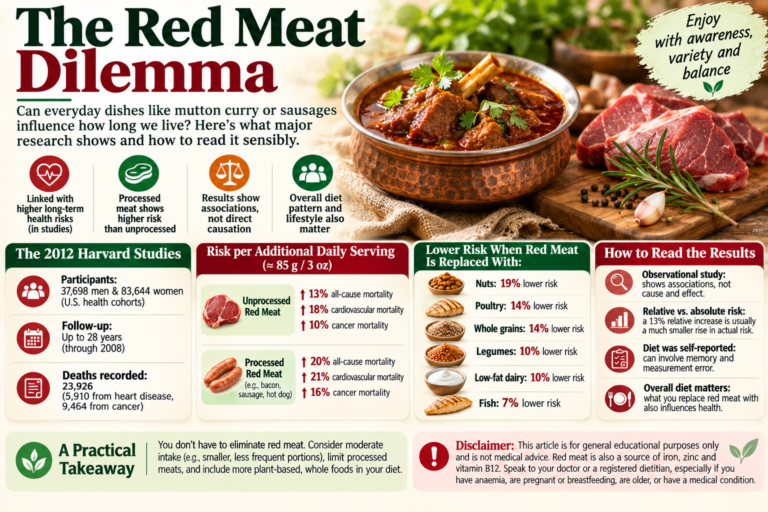
Can everyday dishes like a fragrant mutton curry or weekend breakfast sausages influence how long we live? For decades, dietary…
