
Nature’s Secret Weapon for Heart Health
When we think of heart health, our minds usually jump to cutting back on salt, lacing up running shoes, or…
For nearly two decades, one legume enjoyed a rare privilege in American nutrition: an official government-backed health claim linking it directly to a lower risk of heart disease. Food manufacturers printed that promise across cartons of soy milk, protein bars, and meat alternatives. Then, in 2017, the very agency that approved the claim proposed taking it back, pointing to years of inconsistent clinical trial results.
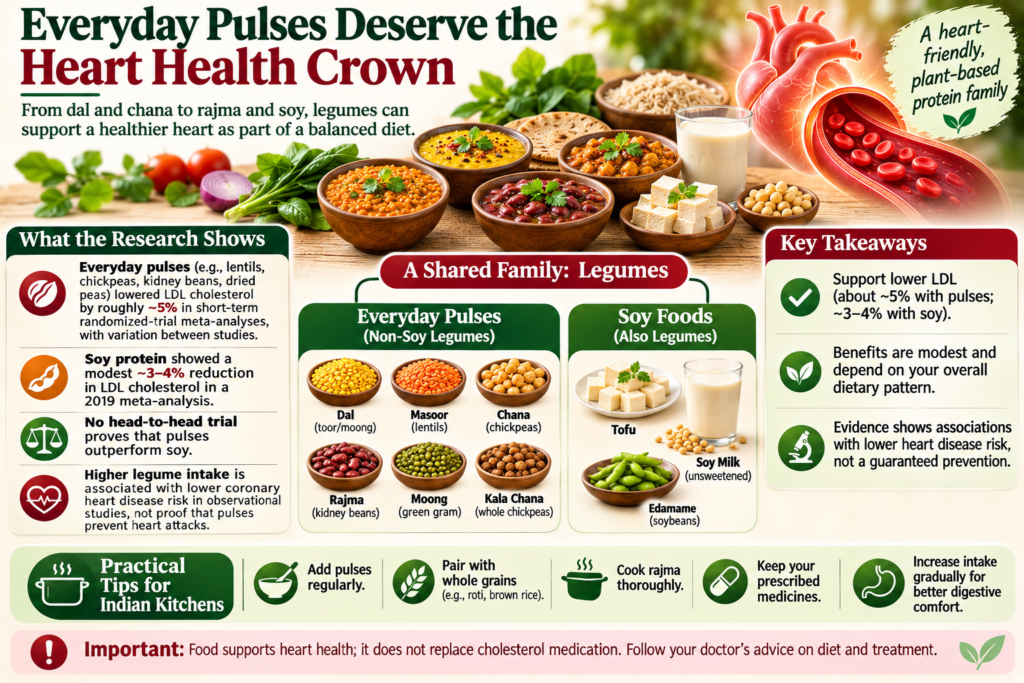
While that regulatory debate played out in the headlines, a quieter body of nutrition science was building around everyday, non-soy pulses such as chickpeas, lentils, kidney beans, and dried peas. Across multiple clinical trials, regular servings of these pantry staples have shown a modest, repeatable ability to nudge down low-density lipoprotein (LDL), often called “bad” cholesterol.
Understanding what actually happened to the soy claim, what soy still contributes to a balanced diet, and what clinical trials truly show about everyday pulses can help you make smarter choices at the grocery store. For Indian households, where dals and chana have been dietary staples for generations, this evidence offers practical lessons on how to support heart health safely and affordably without falling for overstated superfood hype. Choosing a varied, plant-rich diet also fits into broader approaches to everyday nutrition, including the benefits discussed in how simple vegetables help the liver fight everyday toxins.
Medical Disclaimer: This article is for general educational purposes and is not medical advice. Eating more pulses can modestly lower LDL cholesterol but does not replace treatment. Do not stop or change cholesterol medicine, and speak to your doctor about your own heart risk and diet, especially if you have kidney disease or a digestive condition.
To understand why nutrition experts talk carefully about legumes and heart health today, it helps to look at how soy first earned its official health label in the United States and why regulators later reconsidered it.
In October 1999, the US Food and Drug Administration (FDA) authorised an unqualified health claim under federal regulation 21 CFR 101.82 linking soy protein to a reduced risk of coronary heart disease. Under this rule, qualifying food labels were permitted to state that consuming 25 grams of soy protein a day, as part of a diet low in saturated fat and cholesterol, may reduce the risk of heart disease.
To carry the claim, a packaged food had to supply at least 6.25 grams of soy protein per serving (one-fourth of the 25-gram daily target) while also meeting strict limits for total fat, saturated fat, cholesterol, and sodium. At the time, the FDA concluded that clinical studies submitted in the late 1990s provided consistent scientific agreement that soy protein could lower total and LDL cholesterol levels.
Eighteen years later, on October 31, 2017, the FDA took an unprecedented regulatory step: it proposed revoking the soy protein heart-health claim, marking the first time the agency had ever moved to rescind an authorised health claim. After reviewing 709 scientific publications, including dozens of clinical trials published after 1999, the agency concluded that the evidence no longer met the high standard of “significant scientific agreement,” citing inconsistent findings on whether soy protein reliably lowers LDL cholesterol.
Even earlier, in 2008, the American Heart Association had noted that the direct cardiovascular benefit of soy protein or isoflavone supplements appeared minimal at best. Soy industry groups pushed back against the FDA’s proposal, pointing out that Health Canada had approved its own soy cholesterol-lowering claim in 2015. Under the FDA’s proposal, companies were allowed to keep using the existing label until a final rule was issued, and the agency noted it could still allow a weaker “qualified” health claim. As of the latest federal regulatory updates, 21 CFR 101.82 remains listed in the Code of Federal Regulations while final agency action stays pending.
The FDA’s 2017 proposal led many shoppers to assume that soy had been debunked as a healthy food. That conclusion goes far beyond what the science actually shows.
In 2019, researchers published a comprehensive meta-analysis in the Journal of Nutrition examining the exact 46 clinical trials the FDA had used to evaluate the soy claim (Blanco Mejia et al.). Across those studies, consuming a median of 25 grams of soy protein per day lowered LDL cholesterol by roughly 3% to 4% compared with non-soy control diets. While that reduction is smaller than early 1990s estimates had suggested, the study authors noted it remains a clinically meaningful, albeit modest, benefit that supports increasing plant protein intake.
Furthermore, looking at isolated soy protein in a clinical trial misses how people eat in real life. Whole and minimally processed soy foods, such as tofu, tempeh, edamame, and unsweetened soy milk, offer far more than isolated protein powders or supplements. When these foods replace animal proteins high in saturated fat, such as fatty cuts of red meat, full-fat paneer, or processed meats, cholesterol levels improve through both the addition of plant compounds and the reduction of saturated fat. Finally, it is worth remembering a basic botanical fact: soybeans are themselves legumes. Framing the conversation as “soy versus pulses” overlooks the fact that soy belongs to the very same plant family.
When nutrition researchers talk about “pulses,” they are referring to the dry, edible seeds of legume plants, excluding oilseed legumes like soybeans and peanuts. Common examples include chickpeas (chana), lentils (masoor), dried peas (matar), and various beans (such as rajma and lobia). Over the past fifteen years, several systematic reviews have tested what happens when people eat these everyday foods regularly.
One of the most widely cited evaluations was published in the Canadian Medical Association Journal (CMAJ) in 2014 by Vanessa Ha and colleagues. The research team pooled data from 26 randomised controlled trials involving 1,037 adult participants who followed diets emphasising beans, chickpeas, lentils, or dried peas.
At a median intake of 130 grams per day (roughly one cooked serving) over a median duration of six weeks, diets enriched with pulses lowered LDL cholesterol by an average of 0.17 mmol/L (about 6.5 mg/dL). From a typical baseline LDL level of roughly 3.5 mmol/L, that translates to a reduction of about 5%. However, the authors urged careful interpretation: results varied considerably across individual trials, most studies were short, and pulses showed no significant effect on other lipid markers such as apolipoprotein B (apoB) or non-HDL cholesterol. Because the review excluded soybeans and peanuts, the authors also emphasised the need for longer, higher-quality clinical trials.
Those findings aligned closely with an earlier meta-analysis published in Nutrition, Metabolism and Cardiovascular Diseases in 2011 by Lydia Bazzano and colleagues. Reviewing 10 randomised controlled trials involving 268 participants over at least three weeks, the researchers found that diets rich in non-soy legumes lowered total cholesterol by an average of 11.8 mg/dL and reduced LDL cholesterol by 8.0 mg/dL compared with control diets, representing roughly a 5% drop in LDL.
Lipid numbers in short clinical trials only tell part of the story. A 2019 review of prospective cohort studies published in Advances in Nutrition examined long-term eating patterns across large populations. Pooling 12 observational studies, the review found that higher legume consumption was associated with roughly a 10% lower risk of coronary heart disease (a relative risk of 0.90). Because observational studies track habits rather than assign treatments, this finding shows a statistical association rather than proof of cause and effect, and clinical trials have not yet proven that eating pulses directly prevents heart attacks.
It is tempting to look at the FDA’s soy debate alongside the pulse meta-analyses and declare everyday lentils or chickpeas the clear winner. However, doing so stretches the evidence beyond what researchers have actually tested.
None of the major meta-analyses summarised above compared non-soy pulses and soy foods head to head within the same randomised trial. When you place the best available estimates side by side, a roughly 5% LDL reduction for everyday pulses and a 3% to 4% reduction for soy protein are remarkably close, especially considering they come from separate studies with different participants, baseline cholesterol levels, and background diets. Rather than treating legumes as competitors, the more accurate takeaway is that both soy and non-soy pulses support heart health, and swapping out refined carbohydrates and saturated-fat-heavy foods for any legume is a worthwhile move.
Pulses do not rely on a single magic compound to influence blood lipids. Instead, several nutritional properties work together during digestion and across your overall diet:
On paper, Indian cuisine appears ideally suited to capture the cardiovascular benefits of legumes. Yet national nutrition surveys reveal a surprising gap between culinary tradition and what actually lands on the average plate.
The Dietary Guidelines for Indians (2024), issued by the Indian Council of Medical Research and the National Institute of Nutrition (ICMR-NIN), strongly encourage eating plenty of vegetables and legumes every day, recommending roughly 85 grams of raw pulses per day (or an equivalent combination with animal protein sources for non-vegetarians) as part of a balanced adult diet.
However, a 2026 study published in Sarvekshana, the official journal of the National Sample Survey Office (NSSO), found that India’s pulse production and household consumption fall well below the ICMR-NIN benchmark of 85 grams per day across every Indian state, even as refined cereals remain overconsumed. Traditional Indian cooking certainly features pulses, but portion sizes are often too small, or drowned in heavy starches, to match the intake levels studied in clinical trials.
Whether your kitchen stocks toor (arhar), masoor, urad, chana dal, moong, rajma, or whole kala chana, all of these belong to the broader pulse family. While clinical trials have mostly tested common Western varieties like chickpeas, green or brown lentils, and kidney beans rather than specific Indian dals like toor or urad, their similar fibre and plant-protein profiles suggest they are likely to offer comparable benefits.
To bring your daily intake closer to the roughly 130 grams of cooked pulses (about half to three-quarters of a cup, depending on thickness) used in clinical trials:
A varied diet that includes fibre-rich foods can also support digestive health. For more context on how dietary habits and fibre relate to digestion, see the connection between childhood constipation and cow’s milk.
Pulses are safe, wholesome foods for most people, yet a few practical precautions matter, particularly if you are increasing your intake or managing a health condition:
Clinical trials showing modest LDL cholesterol reductions used a median intake of about 130 grams of cooked pulses per day, which equals roughly half to three-quarters of a cup of cooked beans, chickpeas, or thick dal. For Indian adults, the ICMR-NIN Dietary Guidelines (2024) recommend roughly 85 grams of raw pulses daily as part of a balanced vegetarian diet, which yields roughly one to one-and-a-half cups once cooked.
Yes. Although the US FDA proposed revoking its original 1999 heart-health claim due to mixed trial results, a 2019 meta-analysis of 46 trials confirmed that soy protein still lowers LDL cholesterol by about 3% to 4%. Whole and minimally processed soy foods like tofu, tempeh, edamame, and soy milk remain nutritious, affordable sources of plant protein that work well alongside traditional dals.
No clinical trial has proven that one specific Indian dal outperforms another for cholesterol control. Most studies tested chickpeas, lentils, peas, and beans as a group, meaning toor, masoor, moong, urad, chana dal, and rajma are likely to offer similar benefits. Rotating different dals and whole legumes across the week gives you the widest mix of fibre, protein, and micronutrients.
No. Eating a daily serving of pulses typically lowers LDL cholesterol by around 5%, which is far smaller than the effect of prescribed statins or other lipid-lowering drugs. Pulses work best as part of an overall heart-healthy eating pattern alongside regular exercise and your doctor’s prescribed treatment plan.
When we think of heart health, our minds usually jump to cutting back on salt, lacing up running shoes, or…
Can everyday dishes like a fragrant mutton curry or weekend breakfast sausages influence how long we live? For decades, dietary…
We rarely think about the quality of the air inside our homes. Most of us spend the vast majority of…
