
Prescriptions or Plants? Can a Plant-Based Diet Reduce Medication?
If you have type 2 diabetes, high blood pressure or high cholesterol, you may have wondered whether changing what you…
Allergic conditions in children have become far more common over the past few decades. Food allergy, asthma, hay fever and eczema now affect millions of families, and many parents worry about them long before their baby is born.
For years, the advice sounded simple. Pregnant and breastfeeding mothers were told to avoid nuts, eggs and fish. Babies were to be kept away from these foods until the age of two or three. Many parents and grandparents followed this guidance carefully and in good faith.
Over the past decade, however, large clinical trials have overturned much of that thinking. We now know that avoiding these foods does not protect most children, and that introducing some of them early may lower the risk of allergy.
In this article, we look at what mothers should eat during pregnancy, what the landmark LEAP trial found, what current guidelines recommend, how to introduce allergenic foods safely, and what all of this means for Indian families.
Important: This article is for general educational purposes and is not medical advice. Do not introduce peanut or other allergenic foods on your own if your baby has severe eczema, a known food allergy, or has had a reaction to food. Speak to your paediatrician or an allergist first. Seek emergency help for breathing difficulty, swelling or collapse after eating.
As allergic diseases became more common, doctors looked for ways to protect children. Avoidance seemed the obvious answer. If a food can trigger a reaction, keeping a baby away from it for as long as possible appeared to be the safest choice.
That logic shaped feeding advice in many countries through the 1990s and early 2000s. Yet allergy rates kept rising, even in families that followed the rules closely.
Researchers then noticed something that did not fit. In some countries, babies were routinely given foods such as peanut early in life, and those countries did not have more food allergy. In some cases, they appeared to have less. This raised an uncomfortable possibility: delaying certain foods might not be protective at all, and could even make allergy more likely.
To test this properly, scientists needed large, well-designed trials rather than observations alone. Two big questions guided that work:
The answers to both questions have changed how doctors advise families today.
Early observational studies suggested that a mother’s diet during pregnancy might shape her baby’s immune system. Some doctors took this to mean that cutting out allergenic foods such as eggs, nuts and fish could lower the baby’s risk of allergy. Others suggested the opposite, that certain foods might offer protection. Neither idea had been tested in large randomised trials, and later guidelines stopped recommending that mothers avoid these foods.
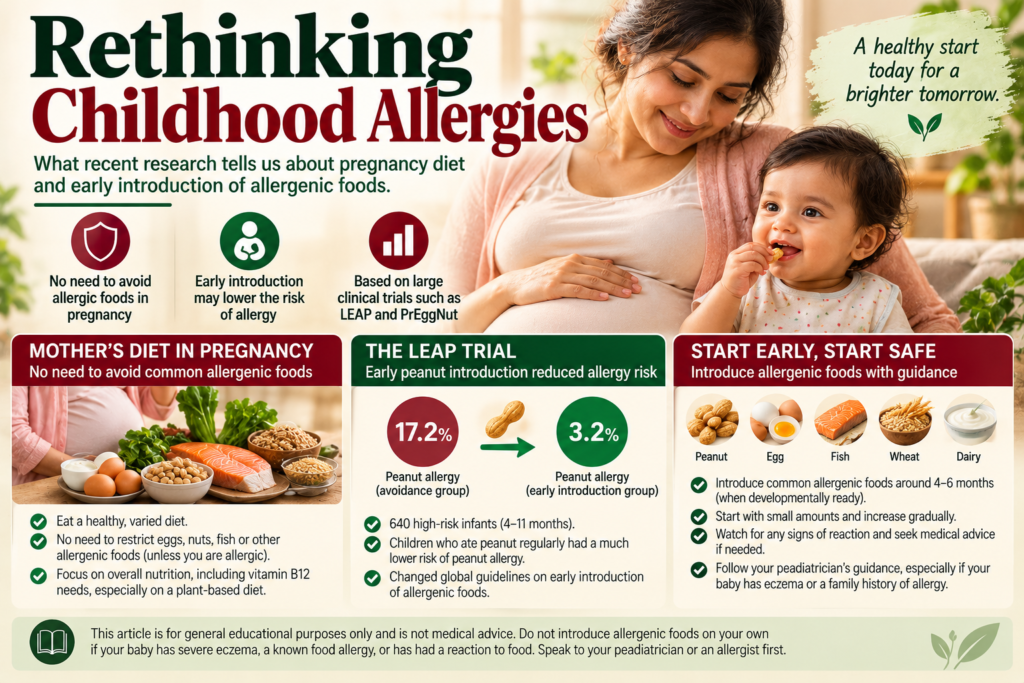
The clearest answer so far comes from the PrEggNut trial, published in the New England Journal of Medicine in 2026. Researchers enrolled 2,137 pregnant women in four Australian cities. Their babies were at higher risk of allergy because of a strong family history.
The women were randomly assigned to one of two diets from mid-pregnancy until their babies were four months old and breastfeeding:
At age one, egg or peanut allergy was found in 7.8% of babies in the high-intake group and 8.4% in the standard group. This difference was not statistically significant.
The takeaway is reassuring. Mothers do not need to eat large amounts of these foods to protect their babies, and the advice not to avoid them still stands. The authors note one limitation: allergy rates were lower than expected (about 8% rather than 16%), which may have made a small benefit harder to detect.
A healthy, varied diet is the sensible approach during pregnancy and breastfeeding. There is no need to restrict allergenic foods, and no need to overeat them either. Pay attention to overall nutrition, including vitamin B12 needs during pregnancy and breastfeeding, especially on a plant-based diet. A mother who is herself allergic to a food should, of course, keep avoiding it.
The story began with an observation. Researchers at King’s College London compared Jewish schoolchildren in the UK with Jewish schoolchildren in Israel, two groups with similar genetic backgrounds. Peanut allergy affected 1.85% of children in the UK but only 0.17% in Israel, roughly a ten-fold difference (Du Toit et al., 2008).
The most obvious difference was diet. In Israel, peanut-based snacks are commonly given to babies in their first year, while UK families at the time were told to avoid peanut. This observation could not prove cause and effect on its own, but it prompted a proper trial.
The Learning Early About Peanut Allergy (LEAP) trial was published in the New England Journal of Medicine in 2015. It enrolled 640 infants aged 4 to 11 months who were at high risk of peanut allergy because they had severe eczema, egg allergy, or both. Babies with a strongly positive skin test to peanut were excluded.
The infants were randomly assigned either to eat peanut-containing food regularly or to avoid peanut completely until age five.
The results were striking. At five years:
It is important to be clear about what this means. These results apply to high-risk infants. Early peanut greatly reduced the risk of allergy, but it did not prevent allergy in every child.
A follow-up study, LEAP-On, asked whether children had to keep eating peanut to stay protected. Children from both groups avoided peanut for 12 months. Afterwards, allergy rates were still much lower in the early-consumption group (4.8% versus 18.6%), showing that the protection persisted. A longer follow-up to age 12, called LEAP-Trio, has since been reported and adds to the evidence that the benefit lasts.
After LEAP, the US National Institute of Allergy and Infectious Diseases (NIAID) issued addendum guidelines in 2017. Their key point is that timing depends on a baby’s risk level:
| Baby’s risk level | What the guideline advises |
|---|---|
| Severe eczema, egg allergy, or both | Strongly consider testing and medical evaluation, then introduce peanut-containing foods from about 4 to 6 months |
| Mild to moderate eczema | Introduce peanut-containing foods at around 6 months |
| No eczema or food allergy | Introduce peanut-containing foods at an age-appropriate time, in line with family and cultural preferences |
These guidelines were written for the United States. Other expert bodies, including the American Academy of Pediatrics (AAP) and the British Society for Allergy and Clinical Immunology (BSACI), have since issued similar advice that moves away from delay and avoidance.
In Europe, the 2020 EAACI guideline (Halken et al., 2021) looked at a wider range of foods. It suggests:
The guideline also found insufficient evidence to recommend fish oil or vitamin supplements in pregnancy or infancy as a way to prevent food allergy.
The steps below reflect general guidance from NIAID, EAACI and national bodies. They are not a substitute for advice from your own paediatrician, especially if your baby is at higher risk.
The honest answer is that good, nationwide data on food allergy in Indian children are limited. Most Indian studies come from hospital clinics, often involving people who already have respiratory allergies. Many measure sensitisation (a positive skin or blood test) rather than confirmed allergy, which is not the same thing.
With those limits in mind, Indian studies have reported sensitisation to foods such as egg, milk, wheat, chickpea and other legumes, and in some studies banana, brinjal and sesame. Patterns vary from region to region and study to study, so no firm ranking can be given for Indian children as a whole.
Peanut is a different story from the West. Indian paediatricians report that peanut allergy is comparatively uncommon here, and peanuts are a familiar part of many Indian kitchens.
For parents who want to understand other food-related symptoms in children, our article on childhood constipation and cow’s milk explores one specific issue involving food and children’s health.
Indian infant feeding guidance already recommends starting a variety of home-cooked foods at about 6 months, alongside continued breastfeeding. Mothers do not need to restrict their diet during pregnancy or breastfeeding unless there is a medical reason.
The practical message is to introduce a variety of foods, including common allergens, in age-appropriate forms, following your paediatrician’s advice. If your family has a history of allergy, discuss your region’s common allergens with your doctor. Pair this with a varied, colourful diet as your child grows.
For practical ideas on encouraging balanced eating habits as children grow, read our guide on how to help kids eat healthier at home.
It also helps to separate two kinds of allergy. Many Indian children struggle with respiratory allergies, often linked to triggers such as house dust mites and air pollution. Early food introduction is a strategy for reducing food allergy risk. It is not a way to prevent asthma, hay fever or eczema, and the trials described here do not show that it does.
Parents can also learn more about ingredients in everyday foods in our article on food additives and their potential effects.
Should I avoid eggs and peanuts while pregnant or breastfeeding?
No. Current guidelines advise against avoiding these foods unless you are allergic to them yourself. Eating extra amounts does not appear to add protection either. A balanced, varied diet is best.
When can I give my baby peanut?
For most babies, peanut can be introduced in a safe, smooth form once solids have started, usually around 6 months. Never give whole nuts.
My baby has eczema. Is it safe to start peanut at home?
If the eczema is severe, or your baby has egg allergy, see a doctor before starting. Your doctor may recommend testing or a supervised first feed.
Do I still need to introduce egg and milk-based foods if allergy is not common in our family?
Yes. Offering a variety of foods, including well-cooked egg and dairy foods suitable for your baby’s age, supports good nutrition. Ask your paediatrician about the right timing for milk products.
If you have type 2 diabetes, high blood pressure or high cholesterol, you may have wondered whether changing what you…
Eggs are a familiar part of everyday life in India. They are boiled for breakfast, turned into bhurji, added to…
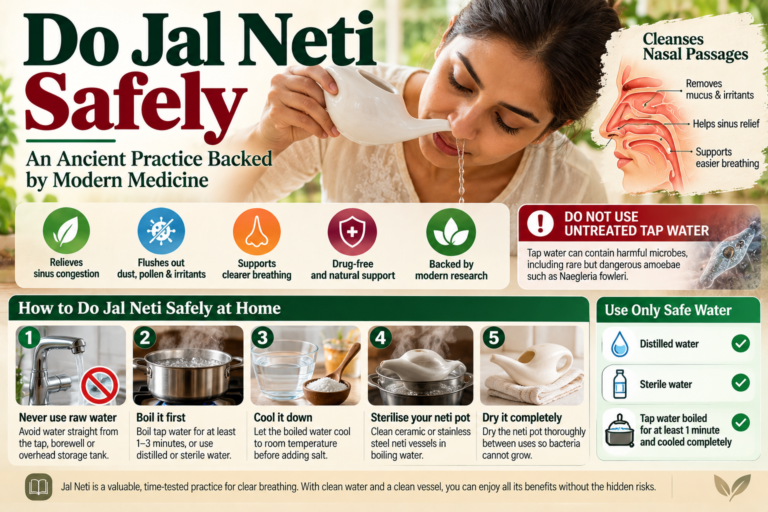
An Ancient Practice Backed by Modern Medicine Using a neti pot to flush the nasal passages with salt water is…
