

Red Vegetables and Living Cells Are Rewriting the Rules
Medical Disclaimer: This article is for general educational purposes and is not medical or nutritional advice. Research on antioxidant activity…
When it comes to vitamin B12, the biggest obstacle to maintaining healthy levels is rarely how much you consume. The real challenge lies in how your gut absorbs it in a single sitting. Unlike many other nutrients that enter your bloodstream with relative ease, B12 relies on a specialized, highly regulated digestive system. Because your body can only process a small amount at one time through its primary pathway, simply taking a high-dose pill or eating a single B12-rich meal does not guarantee your body will utilize all of it.
Understanding vitamin B12 intake is only one part of maintaining adequate B12 status. Knowing when testing may be useful, how deficiency is assessed, and which factors can affect absorption is equally important. For a deeper look at these questions, read our guide to vitamin B12 testing and the Active B12 test
Disclaimer: This article is for general educational purposes and is not a substitute for professional medical advice, diagnosis, or treatment. Supplement doses and routines should be confirmed with a doctor or registered dietitian, especially if you are pregnant, breastfeeding, or managing a health condition. Please consult a physician before starting any new supplement.
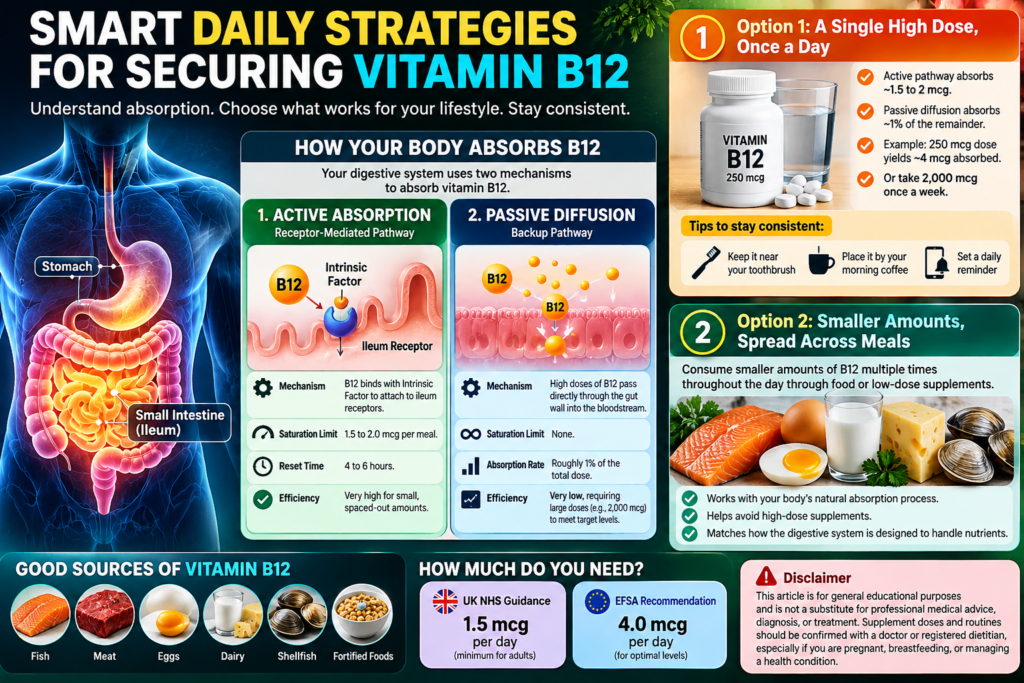
To choose the right intake strategy, it helps to understand how B12 moves from your food or supplement into your bloodstream. Your digestive system relies on two distinct mechanisms to process cobalamin (the chemical name for vitamin B12): an active, receptor-mediated route and a passive diffusion route.
The primary pathway for absorbing B12 requires a specific protein produced in the stomach called intrinsic factor. Intrinsic factor binds to B12 in the small intestine, creating a compound that attaches to specialized receptors in the lower part of the gut (the terminal ileum).
However, this receptor system has a strict operational capacity. Research indicates that these receptors become saturated after absorbing roughly 1.5 to 2 micrograms (mcg) of B12 in a single meal or dose. Once these receptors are full, the body cannot absorb more B12 through this active pathway for several hours typically taking about four to six hours to reset and regain full capacity.
Active Absorption (Receptor-Mediated):
Because the active receptor pathway saturates so quickly, your body employs a secondary mechanism: passive diffusion. Through passive diffusion, B12 passes directly through the mucosal membrane of the gut wall into the bloodstream without needing an intrinsic factor or specialized receptors.
This passive route is far less efficient, absorbing only about 1% (and up to 1% to 3% in some individuals) of the total amount consumed. However, because passive diffusion operates independently of receptor saturation, it allows your body to absorb meaningful quantities of B12 when given very large doses, compensating for its low efficiency through sheer volume.
Passive Diffusion (Backup Pathway):
The mechanics of passive diffusion make a single daily high-dose supplement a convenient strategy for many people. When you take a supplement containing a high concentration of B12, your active receptors quickly absorb their maximum allowance of roughly 1.5 to 2 mcg. The remaining portion of the supplement then relies on passive diffusion.
For instance, if a supplement provides 250 mcg, active absorption accounts for around 1.5 to 2 mcg, while passive diffusion absorbs approximately 1% of the remainder (about 2.5 mcg). Combined, this yields roughly 4 mcg of absorbed B12 more than enough to meet daily biological requirements.
For those who prefer even fewer steps, taking a larger dose of 2,000 mcg once a week relies almost entirely on passive diffusion to deliver a full week’s worth of B12 in one go.
To make this strategy stick, anchor it to an established daily habit:
A common recommendation for people choosing this option is to opt for a reliable daily supplement or a weekly high dose, ensuring consistent coverage without needing to track intake throughout the day.
If you prefer to avoid high-dose supplements, you can rely entirely on your body’s active receptor system by consuming smaller amounts of B12 multiple times throughout the day. This food-first or low-dose strategy aligns directly with how the digestive tract evolved to handle nutrients.
To understand how spaced-out doses work, it helps to look at baseline dietary recommendations:
Because the active receptor system requires roughly four to six hours to reset after reaching its 1.5 to 2 mcg ceiling, consuming B12 at breakfast, lunch, and dinner maximizes total daily absorption.
For example, consuming a fortified plant milk at breakfast, a dish made with fortified nutritional yeast at lunch, and a B12-fortified staple at dinner allows your active transport mechanism to reset between meals. Each meal yields its own ~1.5 mcg through active absorption, easily satisfying EFSA’s 4.0 mcg benchmark through natural digestion.
Choosing fortified foods does not have to make everyday meals expensive. Comparing product labels, checking the amount of vitamin B12 per serving, and selecting affordable options can help people plan their intake more practically. Our guide to eating healthy on a budget offers additional ideas for making nutritious food choices while managing grocery costs.
Fortified Foods:
Daily or Weekly Supplements:
For healthy adults, either approach is valid. However, if a medical professional has diagnosed an active deficiency or absorption issue, moving from lifestyle management to structured medical treatment becomes necessary.
While B12 is synthesized exclusively by microorganisms and is not naturally present in plant foods, B12 insufficiency is not limited to vegans and vegetarians.
Plant-based diets can include a wide variety of pulses, grains, fruits, and vegetables, but variety alone does not guarantee an adequate vitamin B12 intake. People following vegetarian or vegan diets should pay particular attention to reliable B12 sources, including appropriately fortified foods or supplements when needed. Our guide to plant foods and dietary diversity provides further reading on the variety of plant foods included in everyday diets.
Vitamin B12 is essential for maintaining nerve sheath health, supporting cognitive function, and producing red blood cells. In animal-derived foods, B12 is bound to proteins and requires robust stomach acid and enzymes to break free before it can bind to intrinsic factor.
As people age, stomach acid production often decreases – a condition known as hypochlorhydria. Additionally, medications like proton pump inhibitors (PPIs) for acid reflux or metformin for blood sugar management can impair B12 absorption from food. Consequently, adults over 50 and those on long-term medications often face B12 depletion regardless of how much meat or dairy they consume. Building a reliable B12 intake routine benefits individuals across all dietary backgrounds.
Vitamin B12 deficiency represents a critical public health challenge in India, affecting diverse demographic groups across both urban and rural settings.
Rather than being an isolated concern, clinical literature highlights widespread deficiency across the country. Multiple epidemiological studies report that B12 deficiency in India spans a broad range, roughly 47% to 71% depending on the region, population group, and diagnostic threshold used. A comprehensive perspective from North India and regional cohort studies consistently demonstrate that over half of tested individuals display inadequate serum B12 levels.
Several cultural and culinary factors contribute to these figures:
Because vitamin B12 deficiency can have several causes, dietary habits alone may not explain an individual’s B12 status. People experiencing persistent symptoms or those with recognised risk factors should discuss appropriate assessment with a qualified healthcare professional. Our article on the Active B12 test and vitamin B12 deficiency explains why testing decisions and interpretation of results deserve careful attention.
Given the high prevalence of deficiency, public health experts and medical practitioners increasingly advocate for systemic solutions alongside personal intake strategies:
Both approaches are effective. Taking a lower dose daily relies on a combination of active receptor absorption and mild passive diffusion, while taking a high dose (such as 2,000 mcg) once a week relies primarily on passive diffusion. Choose the frequency you can stick to consistently.
Free B12 found in supplements or fortified foods does not require stomach acid to separate it from complex food proteins, meaning it can be taken with or without meals. However, taking supplements alongside a meal can help minimize potential mild stomach upset and establish a consistent habit.
Yes, provided you consume fortified foods two to three times a day, with several hours between servings to allow your gut’s active absorption receptors to reset. Checking product labels to confirm the exact microgram count per serving is essential.
Studies indicate that B12 deficiency affects roughly 47% to 71% of the population in India, depending on the region and study group. This high prevalence is largely driven by traditional plant-based dietary patterns and heat-based food processing practices.

Medical Disclaimer: This article is for general educational purposes and is not medical or nutritional advice. Research on antioxidant activity…
Medical Disclaimer: The information provided in this article is for educational and informational purposes only and is not intended as…

Every time we flex a muscle, take a breath, or blink an eye, our body spends a tiny packet of…
