

Prescriptions or Plants? Can a Plant-Based Diet Reduce Medication?
If you have type 2 diabetes, high blood pressure or high cholesterol, you may have wondered whether changing what you…
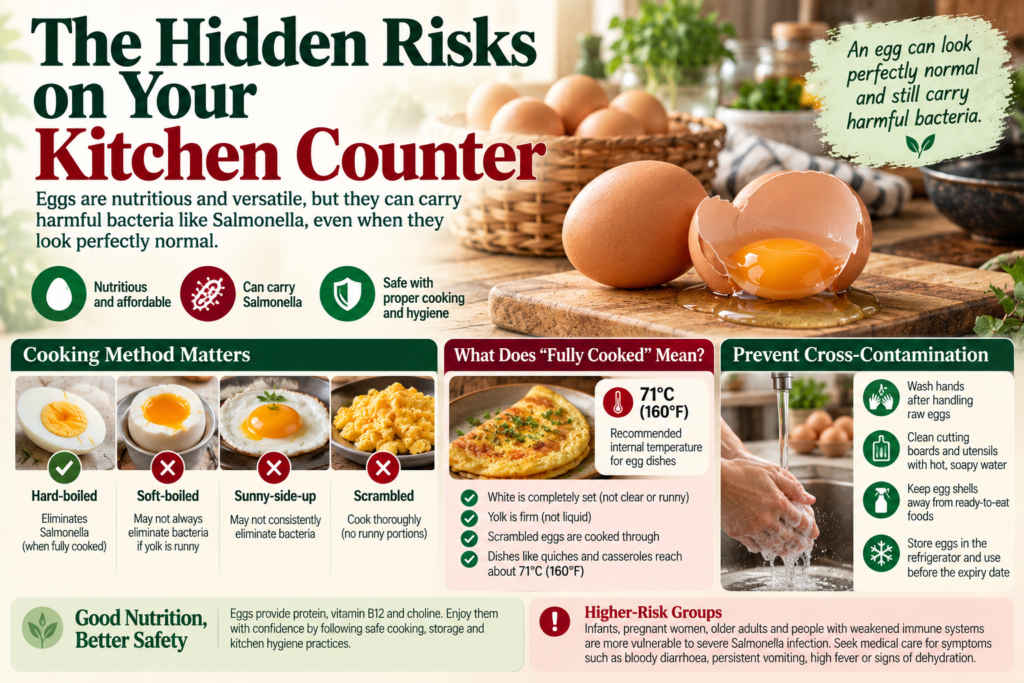
Eggs are a familiar part of everyday life in India. They are boiled for breakfast, turned into bhurji, added to curries and served as half-fry eggs at roadside stalls and cafés. They are affordable, versatile and provide useful nutrients, including protein, vitamin B12 and choline.
But there is one detail about egg safety that deserves more attention: an egg can look perfectly normal and still carry harmful bacteria, and cooking is only one part of keeping it safe.
The usual advice is to cook eggs properly. That sounds simple until you consider what it means in practice. Is a runny yolk safe? Does a fully cooked omelette eliminate every risk? And what happens when raw egg touches your hands, chopping board or kitchen counter before the food reaches the pan?
These questions matter because Salmonella, a bacterium that can cause food poisoning, may be present inside an egg or on its shell. The good news is that you do not need to stop eating eggs. Understanding how cooking, storage and kitchen hygiene work together can help you enjoy them with greater confidence.
Food safety note: This article provides general educational information, not personal medical advice. Infants, pregnant women, adults aged 65 and older, and people with weakened immune systems are more vulnerable to severe Salmonella infection. Seek medical care for concerning symptoms, particularly bloody diarrhoea, persistent vomiting, high fever or signs of dehydration.
When someone says an egg is fully cooked, they usually mean that it has spent enough time in the pan or boiling water. However, cooking time alone does not guarantee safety. Egg size, starting temperature, cooking method and heat distribution can all affect the final result.
For ordinary shell eggs, the US Department of Agriculture recommends cooking until both the white and yolk are firm. Scrambled eggs should not remain runny. Egg dishes such as quiches and casseroles should reach an internal temperature of approximately 71°C (160°F).
At home, the practical signs are straightforward:
A golden-brown surface does not necessarily mean that the centre has reached a safe temperature. Similarly, an egg that looks fresh or smells normal cannot be assumed to be free from Salmonella.
These recommendations are a sensible default for ordinary eggs, particularly when their production and storage history is uncertain. They do not mean that every egg is contaminated or that eggs are inherently unsafe.
Different cooking methods expose eggs to different combinations of heat and time. Scientific studies help explain why the distinction matters.
A study by Davis and colleagues, published in Poultry Science in 2008, examined several cooking methods using shell eggs that had been deliberately inoculated with Salmonella Enteritidis and Salmonella Heidelberg.
The researchers found that hard-cooked, soft-cooked and poached eggs eliminated the bacteria under the study conditions. Sunny-side-up, over-easy and scrambled eggs did not consistently achieve the same result.
This finding needs careful interpretation. The researchers deliberately introduced bacteria into the eggs, so the experiment examined how well different cooking methods dealt with a known contamination challenge. It did not measure how frequently eggs sold in shops are contaminated.
It also shows why simply labelling all eggs with soft yolks as unsafe is too simplistic. Cooking method, time, temperature and the particular preparation all matter. The practical advice for ordinary household eggs remains to cook them thoroughly, especially when serving people who are more vulnerable to foodborne illness.
Research by Humphrey and colleagues, published in Epidemiology and Infection in 1989, investigated the survival of Salmonella in shell eggs cooked under simulated domestic conditions.
The study demonstrated that bacteria introduced into the yolk could survive some cooking conditions, particularly when the yolk remained liquid. It also highlighted the importance of contamination levels and storage conditions.
The lesson is not that every soft-boiled egg will cause illness. Rather, when an egg is contaminated, a cooking method that leaves parts of it insufficiently heated may not reliably eliminate the bacteria.
For everyday meals, this is why cooking until the white and yolk are firm is a useful safety rule when the egg’s history is uncertain.
Most eggs are not contaminated with Salmonella. However, the possibility is real, and the level of risk varies with production systems, hygiene, storage and handling.
The United Kingdom provides a useful example of why the details matter. In 2017, the UK Food Standards Agency changed its advice to allow British Lion-marked eggs to be eaten raw or lightly cooked by groups previously advised to avoid them, including pregnant women, young children and older people. That advice was based on specific production controls, including vaccination and an assurance scheme.
This should not be interpreted as a blanket endorsement of runny eggs everywhere. The assurance attached to a particular egg supply matters, and the UK scheme should not automatically be assumed to apply to eggs sold in India.
For Indian households, cooking eggs until both the white and yolk are firm is a prudent default, particularly when the source and storage history are unclear.
The balanced conclusion is simple: contamination is not inevitable, but careful cooking and handling provide important protection.
Cooking may kill harmful bacteria in food, but it cannot undo contamination that has already spread to other parts of the kitchen.
Think about making an omelette. You pick up an egg, crack it against the edge of a bowl, separate the shell and whisk the contents. You may then reach for a salt container, open the refrigerator, touch a tap or cut a tomato without washing your hands.
If the shell or egg contents carry Salmonella, bacteria may be transferred along this route. They can also reach knives, utensils, worktops and chopping boards.
The omelette might eventually be cooked thoroughly, but that does not make the contaminated tomato, tap handle or other food safe.
This is a form of cross-contamination: the movement of harmful microorganisms from one surface or food to another. It is also a risk when preparing raw poultry, as discussed in our article on the hidden kitchen hazard.
A study by Humphrey and colleagues, published in Epidemiology and Infection in 1994, examined contamination during the preparation of egg dishes using deliberately contaminated eggs.
Researchers recovered Salmonella from kitchen work surfaces more than 40 centimetres from the mixing bowl. They also detected bacteria on utensils and fingers, and found that contamination could remain recoverable from a laminate work surface after 24 hours under the study conditions.
These results show that contamination can travel farther than the immediate area where an egg is cracked. They do not mean that every kitchen will experience the same spread: the eggs were artificially contaminated, and the findings reflect the conditions tested.
The practical point is still important. Wiping a counter quickly or rinsing a utensil may not be enough. Wash hands with soap and water, clean affected equipment and surfaces thoroughly, and keep raw egg away from ready-to-eat foods such as fruit and salad.
In India, eggs may be sold through a variety of outlets, including supermarkets, small grocery shops and local vendors. Some are refrigerated, while others are displayed at room temperature. Storage practices and temperatures can differ considerably between sellers and locations.
Warm conditions matter because Salmonella can multiply more readily at temperatures that are not sufficiently cold. Temperature fluctuations can also affect egg quality and storage life.
A study of eggs sampled from retail markets in Coimbatore, South India, reported Salmonella in 7.7% of 492 eggs examined. The study found bacteria on 5.9% of shells and in the contents of 1.8% of eggs, with higher rates reported during the monsoon.
These figures should be treated carefully. They come from one local study, not a representative survey of every Indian state or the entire national egg supply. They nevertheless illustrate why storage and handling deserve attention.
The Food Safety and Standards Authority of India has published guidance emphasising that storage conditions affect egg quality and recommending refrigeration to help maintain freshness. Where refrigeration is available, keep eggs refrigerated consistently and follow any instructions provided by the seller or packaging.
Traditional Indian preparations such as thoroughly cooked egg curry, bhurji and hard-boiled eggs can fit comfortably into a safe diet when prepared and stored properly.
At the same time, half-fry eggs, sunny-side-up eggs, soft-boiled eggs and runny-yolk café breakfasts are popular with many people. These preparations leave more room for uncertainty if the egg is contaminated and the cooking process does not heat it sufficiently.
The decision deserves particular care when cooking for babies, pregnant women, older relatives or anyone with a weakened immune system. For these groups, fully cooked eggs are the safer everyday choice unless a reliable, relevant food-safety assurance scheme specifically supports another approach.
You do not need complicated equipment to improve egg safety. A few consistent habits can reduce the risk considerably.
These habits are part of a broader approach to food choices and everyday wellbeing. Our guide to eating healthy on a budget explores how practical decisions can help people build a more balanced diet without making healthy eating unnecessarily expensive.
Salmonella infection can affect anyone, but some people are more likely to develop serious complications. These include:
Parents introducing eggs to babies should offer egg that has been cooked thoroughly and prepared in a texture appropriate for the child’s developmental stage. Follow current paediatric feeding guidance if the child has a history of food allergy or other medical concerns.
Symptoms of Salmonella infection commonly include diarrhoea, stomach cramps and fever. Some people also experience nausea or vomiting. Symptoms can vary in severity, and dehydration is a particular concern in young children and older adults.
Seek medical advice if symptoms are severe, persistent or accompanied by blood in the stool, a high fever or signs of dehydration. Do not assume that every episode of stomach upset is food poisoning, and avoid self-diagnosing the cause.
A runny egg may carry a higher food-safety risk if it is contaminated because the yolk or white may not have been heated sufficiently. For ordinary eggs with an uncertain production and storage history, cooking until both the white and yolk are firm is the safer choice, especially for vulnerable people.
There is no single cooking time that guarantees safety for every egg size and starting temperature. Follow a reliable hard-boiling method and check that the yolk and white are fully firm. USDA guidance gives approximately 12 minutes for medium eggs, 15 minutes for large eggs and 18 minutes for extra-large eggs when using its covered, off-heat method after bringing the water to a boil.
No. Avoid washing eggs before storage. Instead, choose clean, uncracked eggs and store them appropriately. Wash your hands and any surfaces that come into contact with raw egg.
Refrigeration is preferable when available, particularly in warm conditions. If you do not have a refrigerator, buy smaller quantities from a reliable seller, keep eggs in a clean, dry, cool place away from direct sunlight, and avoid prolonged storage in heat. These steps cannot provide the same protection as consistent refrigeration, so cook eggs thoroughly and do not rely on appearance or smell alone to judge safety.
Eggs can be a nutritious and affordable part of a balanced diet. Food safety does not require avoiding them; it requires understanding how contamination can occur and how to reduce the risk.
For most households, the most useful habits are simple: choose clean, uncracked eggs, store them appropriately, cook them until the white and yolk are firm, wash hands after handling raw eggs and clean surfaces that may have been contaminated. Take extra care when preparing food for babies, pregnant women, older adults and people with weakened immunity.
The key is to look beyond the pan. Safe cooking, sensible storage and clean kitchen habits work together to make everyday meals safer.

If you have type 2 diabetes, high blood pressure or high cholesterol, you may have wondered whether changing what you…

Allergic conditions in children have become far more common over the past few decades. Food allergy, asthma, hay fever and…

An Ancient Practice Backed by Modern Medicine Using a neti pot to flush the nasal passages with salt water is…
