

A Smarter Approach to Vitamin B12: Why the “Active B12” Test Matters
Medical Disclaimer: The information provided in this article is for educational and informational purposes only and is not intended as…
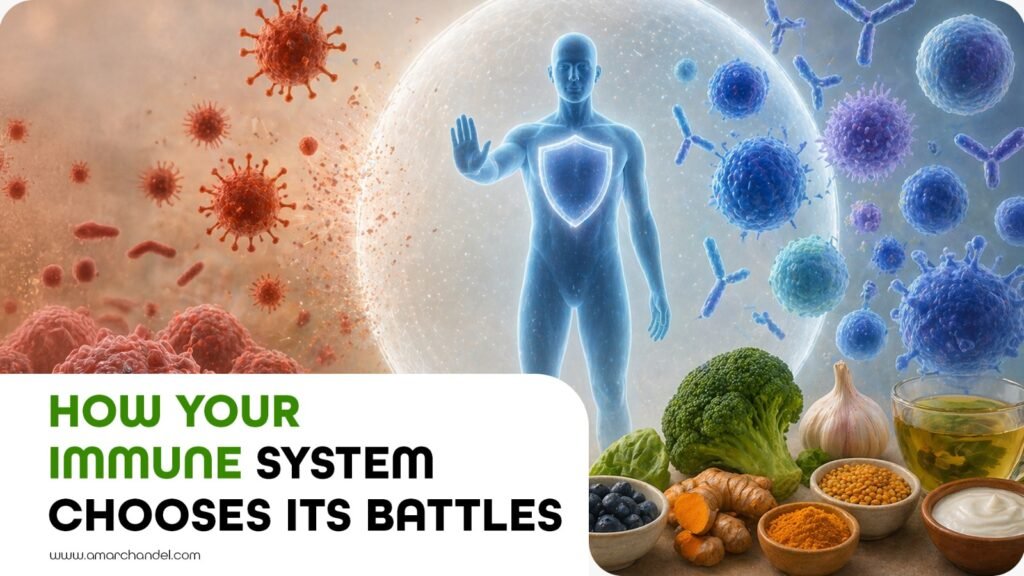
To understand why certain foods might trick our bodies into helping cancer grow, we first need to look at the incredible way our immune system is built. This was one of the biggest puzzles in science until 1960, when Sir Frank Macfarlane Burnet won the Nobel Prize for his Clonal Selection Theory.
Think of your immune system not as a single wall, but as a massive library containing millions of unique “blueprints” for specialised soldiers called B-cells. Each B-cell is designed to recognise and attack exactly one specific target, or antigen. Recent research from 2025, including studies on Indian populations vaccinated during the pandemic, has shown just how vital this diversity is for our long-term survival and how these cells “remember” threats for decades.
The sheer variety of these cells is mind-blowing. You have B-cells in your body right now that are specialised to fight threats you may never even see. For example, you might have a B-cell whose only job is to recognise a rare virus found only in the remote rainforests of the Western Ghats or a specific toxin from a deep-sea creature in the Indian Ocean.
These cells stay quiet and “inactive” for years, just waiting for their specific enemy to show up. This massive internal army is what allows humans to adapt to almost any new disease that emerges in our environment.

The “Clonal Selection” part of the theory explains what happens during a real attack. Imagine you are trekking in the Himalayas and encounter a rare pathogen. For your whole life, the specific B-cell capable of fighting that pathogen has been sitting idle. But the moment it detects that intruder, it “raises its hand” and starts dividing at lightning speed. It creates thousands of identical copies, or clones, of itself. Within days, you have a massive, specialised strike force of antibodies flooding your bloodstream to neutralise the threat.
Once the battle is won, a few of these clones stay behind as “memory cells,” ensuring that if the same intruder ever returns, your body can crush it before you even feel sick.
However, modern science is now looking at the “flip side” of this brilliance. Because our immune system is so good at attacking anything it labels as “foreign,” it can be tricked. Research published in early 2025 in journals like MDPI and Frontiers in Immunology explains that when we eat certain non-human molecules—like the red meat sugar Neu5Gc—our B-cells treat them as invaders. Because these foreign sugars get stuck to our own healthy cells, our immune army ends up attacking our own tissues. This creates a “weak” but constant state of inflammation that tumours actually use as fuel to grow.
By understanding how our B-cells select their targets, we can see why a plant-based diet, common in traditional Indian culture, supports holistic healing and helps keep this internal army from accidentally turning its weapons against us.
Sources
Medical Disclaimer: The information provided in this article is for educational and informational purposes only and is not intended as…

Every time we flex a muscle, take a breath, or blink an eye, our body spends a tiny packet of…

Managing chronic kidney disease through nutrition relies on balancing essential nutrients while minimising the workload on failing kidneys. Damaged kidneys…
