
The Surprising Power of Dietary Antioxidants
Ask almost anyone how to support regular bowel movements and long-term colon health, and the immediate answer is dietary fibre.…
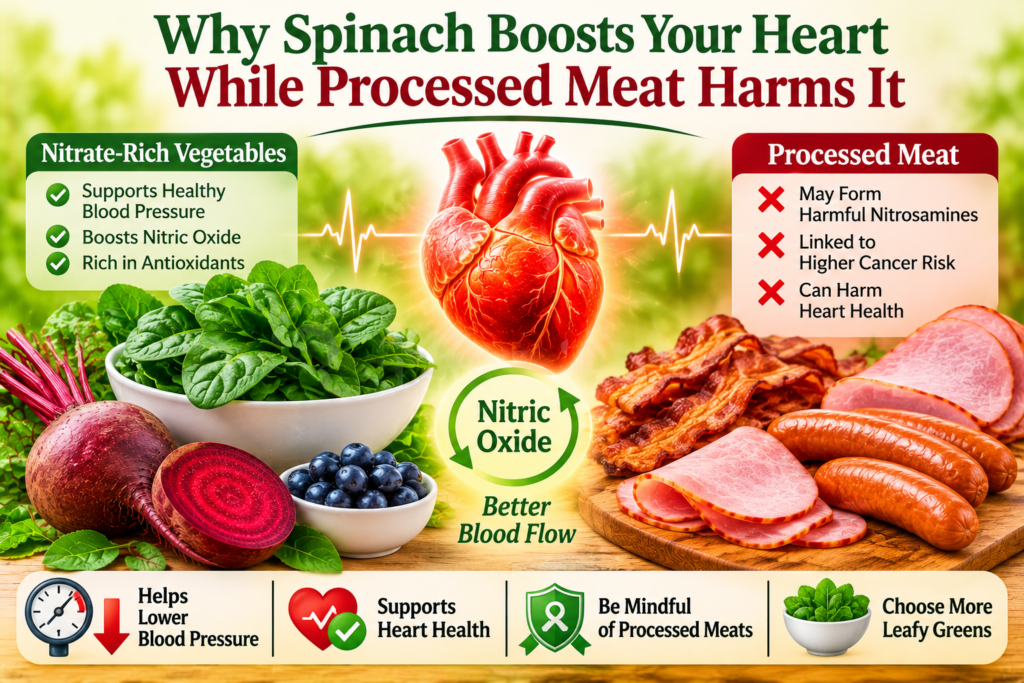
At first glance, nutrition advice around nitrates and nitrites seems to contradict itself. On one hand, public health guidelines warn people to cut back on cured meats like bacon, ham, and sausages, in part because of the nitrite preservatives used to cure them. On the other hand, cardiologists and dietitians encourage eating nitrate-rich vegetables such as spinach, beetroot, and leafy greens to support healthy blood pressure and circulation.
How can the same chemical family sit inside both a heart-friendly salad and a food classified as carcinogenic? The answer comes down to food chemistry and the company those molecules keep. Inside a fresh leaf, nitrates arrive packaged alongside vitamin C, polyphenols, and plant antioxidants that guide the body toward producing blood-vessel-relaxing nitric oxide. Inside cured meat, nitrites meet concentrated animal proteins, heme iron, and high cooking heat, setting off a very different chemical reaction.
In this article, we unpack how nitrates and nitrites behave in plants versus processed meats, what cancer and heart research actually shows, where uncertainties remain, and practical ways Indian households can enjoy leafy greens safely.
Disclaimer: This article is for general educational purposes and is not medical advice. Nitrate-rich vegetables are part of a healthy diet for most people, but nitrate can be a concern for young infants, and some greens affect warfarin or are high in oxalate. Speak to your doctor or a registered dietitian if you have a medical condition or take regular medicines.
Nitrates and nitrites are simple, naturally occurring nitrogen-oxygen compounds found throughout soil, water, plants, and the human body. For most people, roughly 80% of daily dietary nitrate comes from vegetables, with smaller amounts coming from drinking water and animal products.
In the food industry, however, sodium nitrite, potassium nitrite, sodium nitrate, and potassium nitrate are added deliberately as curing agents during the manufacture of bacon, ham, salami, hot dogs, and sausages. Food producers use them for three specific reasons:
Because excessive intake carries health risks, food safety regulators closely control these additives. In the European Union, regulations generally cap added nitrite or nitrate at a maximum of 150 mg per kilogram of meat for most processed products. Following a 2017 scientific re-evaluation, the European Food Safety Authority (EFSA) reaffirmed an acceptable daily intake (ADI) of 0.07 mg per kilogram of body weight per day for nitrite and 3.7 mg per kilogram of body weight per day for nitrate. Notably, the UK Food Standards Agency points out that there is currently no scientific evidence showing that processed meats cured without added nitrites or nitrates are any safer for human health.
When you eat spinach, lettuce, amaranth, or beetroot, your body puts dietary nitrate through a natural recycling pathway. After being absorbed in the upper digestive tract into the bloodstream, roughly a quarter of that nitrate is concentrated by the salivary glands and secreted back into your mouth.
Friendly bacteria living on the surface of your tongue reduce that salivary nitrate into nitrite. Once swallowed into the stomach and bloodstream, nitrite is converted into nitric oxide, a vital gaseous signalling molecule that relaxes smooth muscle cells in blood vessel walls, widens arteries, and supports healthy blood flow. (Because oral bacteria perform the critical first conversion step, strong antiseptic mouthwashes can blunt this beneficial response.)
This pathway is one reason researchers study nitric oxide and cardiovascular health. For a closer look at the role of this molecule in circulation, read our guide to nitric oxide and heart health through leafy greens.
While this biological pathway is well established, human clinical trials testing whether vegetable nitrate consistently lowers blood pressure show mixed results. Several short-term trials demonstrate modest drops in systolic blood pressure, whereas other studies observe little or no lasting change. Across larger observational population studies, regularly eating about one cup of nitrate-rich leafy green vegetables per day is associated with healthier cardiovascular markers and lower rates of heart disease.
If nitrite is simply an intermediate step toward nitric oxide, why does it raise concern in processed meats? The issue arises when nitrite reacts with protein breakdown products to form N-nitroso compounds, commonly known as nitrosamines.
Nitrite can react chemically with amines and amides—compounds abundant in protein-rich meat—to generate nitrosamines. This reaction, called nitrosation, happens in two primary settings: inside the acidic environment of the human stomach after eating, and directly in the pan during high-temperature cooking such as frying bacon or grilling sausages.
According to the UK Food Standards Agency, the degree of nitrosamine formation depends on the specific food matrix, cooking temperature, stomach acidity, and the presence of certain gut bacteria. Furthermore, heme iron, the iron compound naturally abundant in red meat, acts as a catalyst that promotes endogenous nitrosation inside the digestive tract. To limit this reaction during processing, manufacturers frequently add sodium ascorbate or vitamin C to cured meats.
Major cancer and food safety agencies have evaluated these compounds carefully over the past two decades. In its 2010 evaluation (Monograph 94), the International Agency for Research on Cancer (IARC) concluded that ingested nitrate or nitrite is probably carcinogenic to humans (Group 2A) specifically under conditions that result in endogenous nitrosation, while noting insufficient evidence for nitrate in food and limited evidence for nitrite alone. Specific nitrosamines such as N-nitrosodimethylamine (NDMA) and N-nitrosodiethylamine (NDEA) are classified as probable human carcinogens.
In 2015 (published in Monograph 114 in 2018), IARC classified processed meat as carcinogenic to humans (Group 1) based on sufficient epidemiological evidence linking regular consumption to colorectal cancer. Importantly, the UK Food Standards Agency emphasizes that the evidence links overall processed meat consumption—rather than nitrites or nitrates in isolation—to higher bowel cancer risk. Other components of processed meat, including high salt, saturated fat, heme iron, and compounds formed during smoking or charring, likely contribute together. Similarly, a 2012 comprehensive review by Bryan and colleagues noted that newer large cohort studies found no significant association between dietary nitrate or nitrite intake and stomach cancer.
Vegetables contain built-in chemical safeguards that steer nitrite away from harmful nitrosamine formation. Fresh leafy greens and colourful vegetables are rich in vitamin C (ascorbic acid), polyphenols, and other plant antioxidants. When vitamin C and polyphenols are present alongside nitrite in the stomach, they preferentially reduce nitrite to nitric oxide rather than allowing it to bind with amines to form nitrosamines. IARC’s Monograph 94 specifically highlights vitamin C—found abundantly in citrus fruits, kiwi, and fresh vegetables—as an established inhibitor of endogenous nitrosamine formation.
Epidemiological evidence supports this protective food matrix effect. As Harvard Health notes in guidance reviewed by nutrition researcher Dr. Walter C. Willett, diets rich in nitrate-containing vegetables have consistently been associated with lower, not higher, rates of cancer, including stomach cancer. In a Spanish case-control study examining gastric cancer, higher total nitrate intake showed a non-significant overall association (odds ratio 1.42), but among individuals with low intake of vegetables and vitamin C, the association jumped significantly (odds ratio 2.24).
While these observational findings reinforce that dietary context matters, researchers are still testing direct interventions in humans; a registered clinical pilot trial investigating whether vegetable consumption directly suppresses nitrosamine formation after eating nitrite-cured meat (NCT05045807) has been initiated, though published results are not yet available.
A common follow-up question is whether eating bacon, ham, or sausages alongside a bowl of spinach salad or a glass of orange juice cancels out the health risks. The short answer is no.
While pairing vitamin C-rich vegetables with meals may help temper nitrosamine formation in the stomach, no clinical evidence shows that adding salad, fruit, or culinary spices neutralizes the overall cancer risk of processed meat. Because processed meat carries multiple risk factors beyond added nitrites—including heme iron, high sodium, and cooking byproducts—major public health bodies such as the World Cancer Research Fund continue to advise eating little to no processed meat.
Beyond cancer concerns, regular consumption of processed meat is consistently linked to poorer cardiovascular outcomes. In the landmark Harvard cohort analysis by Pan and colleagues (2012) tracking over 120,000 adults for up to 28 years, each additional daily serving of processed red meat was associated with roughly a 21% higher risk of cardiovascular death. Likewise, a large 2023 systematic review and meta-analysis in the European Heart Journal by Shi and colleagues linked higher intakes of both unprocessed and processed red meat to elevated risks of cardiovascular disease and type 2 diabetes.
As with cancer, these findings represent statistical associations from observational studies rather than proof that nitrite alone damages arteries. Processed meats are typically dense in sodium—a primary driver of high blood pressure—as well as saturated fats, making it difficult to separate individual ingredients from the whole food.
A balanced eating pattern also matters. Foods such as lentils, chickpeas and other pulses can contribute fibre and plant protein to heart-conscious meals. Explore our guide to pulses for heart health and cholesterol management for more practical food ideas.
Understanding how nitrate research translates to India requires looking at local eating habits, food safety rules, and traditional vegetables.
Overall processed meat consumption in India remains small compared with Western nations, though demand for packaged sausages, salami, chicken nuggets, and cold cuts has expanded steadily in metropolitan areas alongside quick-service restaurants and modern retail. In India, the Food Safety and Standards Authority of India (FSSAI) regulates sodium and potassium nitrites and nitrates (listed under additive codes INS 249 to 252) through its Food Products Standards and Food Additives Regulations, specifying maximum permitted levels across cured meat categories alongside European Union benchmarks such as the 150 mg/kg limit.
Indian diets rely heavily on local leafy vegetables such as palak (spinach), chaulai (amaranth), methi (fenugreek), and bathua. Natural nitrate levels in these greens vary substantially depending on plant cultivar, sunlight exposure, and soil nitrogen. For example, classic compositional analyses of Indian amaranth leaves (Prakash and Pal, 1991) reported nitrate levels ranging from roughly 180 mg to 880 mg per 100 grams of fresh weight. Recognizing this variation, agricultural scientists at the ICAR-Indian Institute of Horticultural Research (IIHR) have even bred low-nitrate amaranth varieties such as Arka Suguna and Arka Arunima.
Heavy application of nitrogen-rich agricultural fertilizers can elevate nitrate accumulation inside plant leaves. Crucially, washing greens under tap water removes surface dirt and pesticide residues, but it does not wash away nitrate stored inside the leaf cells. Because nitrate is water-soluble, boiling leafy greens in water can reduce their nitrate content substantially—by up to 75% in published cooking reviews—as nitrates leach out into the cooking liquid.
Beetroot is another vegetable often discussed in relation to dietary nitrate and nitric oxide. Its potential role in exercise and circulation is explored further in our article on beetroot juice and exercise performance.
For most healthy Indian adults, leafy greens are an overwhelmingly beneficial food, though a few practical precautions matter:
You do not need to fear nitrates in fresh vegetables or overhaul your kitchen to make evidence-based choices:
For healthy adults and older children, nitrates naturally present in vegetables are considered safe and are associated with positive cardiovascular health markers. Vegetables contain vitamin C and polyphenols that prevent nitrates from forming harmful nitrosamines.
No. Products labelled “uncured” or “no added nitrites” typically use celery juice or celery powder, which is naturally high in nitrate that converts into nitrite during processing. Food safety agencies note there is no evidence these products are safer than conventionally cured meats.
Paediatric nutrition guidelines generally recommend waiting until after six months of age before introducing high-nitrate vegetables such as spinach, beetroot, and amaranth, and avoiding feeding infants leftover cooked greens that have been stored improperly.
No. While vitamin C can reduce nitrosamine formation in the stomach, eating citrus fruit or salad alongside bacon or sausages does not eliminate the colorectal cancer or cardiovascular risks linked to regular processed meat intake.
Ask almost anyone how to support regular bowel movements and long-term colon health, and the immediate answer is dietary fibre.…
When most people picture heart-healthy dried fruits, their minds jump straight to walnuts, almonds, raisins, prunes, or exotic imported berries.…
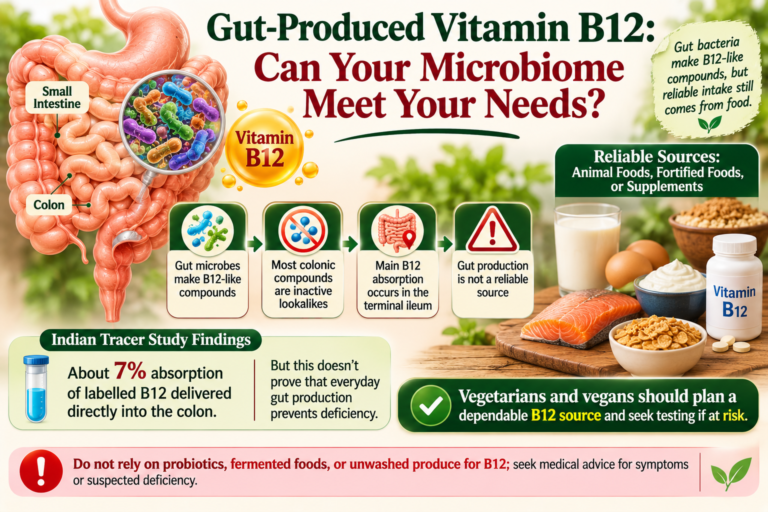
A popular wellness claim suggests that healthy human gut bacteria quietly manufacture all the vitamin B12 our bodies require, and…
